


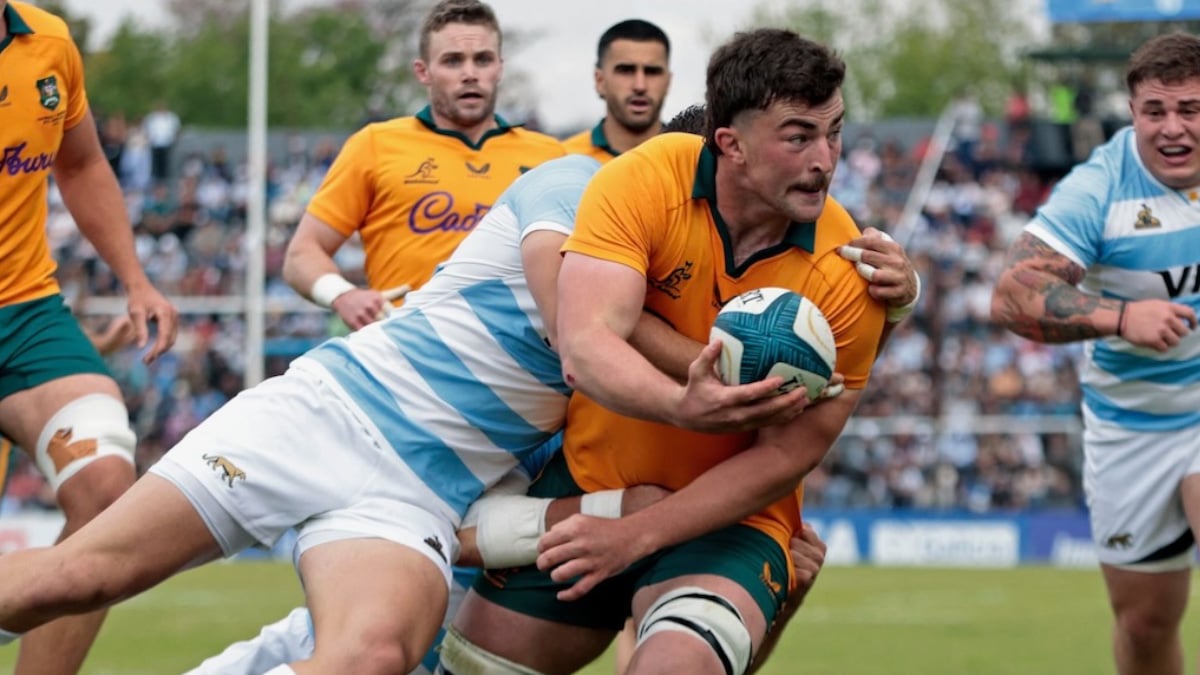
Australia had 62 per cent of the ball in Jujuy, three tries inside twenty minutes, and then almost nothing for half an hour. Matt Giteau has a theory about the gap. Les Kiss watched the same half-hour and prescribed the opposite.
Three tries in twenty minutes. Then one in the next sixty.
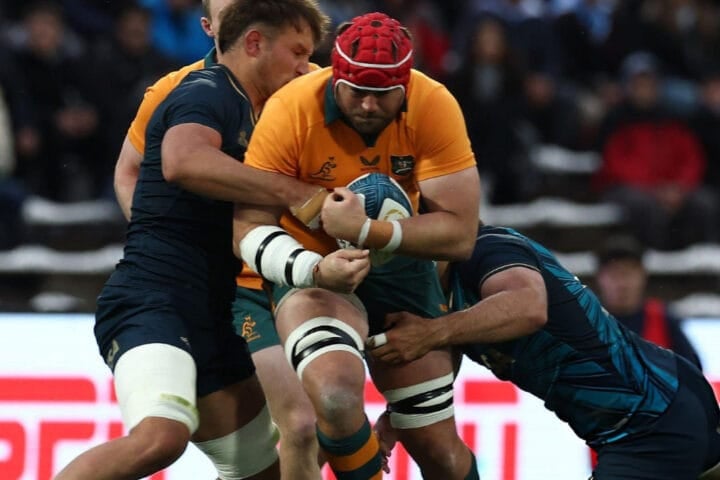
That is the shape of the win, with the team Kiss sent out without Harry Wilson, and it is the shape Les Kiss has to fix before the Wallabies Argentina second Test in Mendoza on Saturday. Australia beat Argentina 27–21 at Estadio 23 de Agosto on Saturday 29 August with 62 per cent of possession, four lineout steals and three scrum penalties by rugby.com.au’s count, and led from the sixth minute to the end. Brandon Paenga-Amosa went over in the sixth minute, Carter Gordon in the tenth, Fraser McReight in the twentieth, and the next Australian try was Tom Hooper’s in the 55th. In between, the Wallabies had most of the ball, most of the penalties, and three points to show for it.
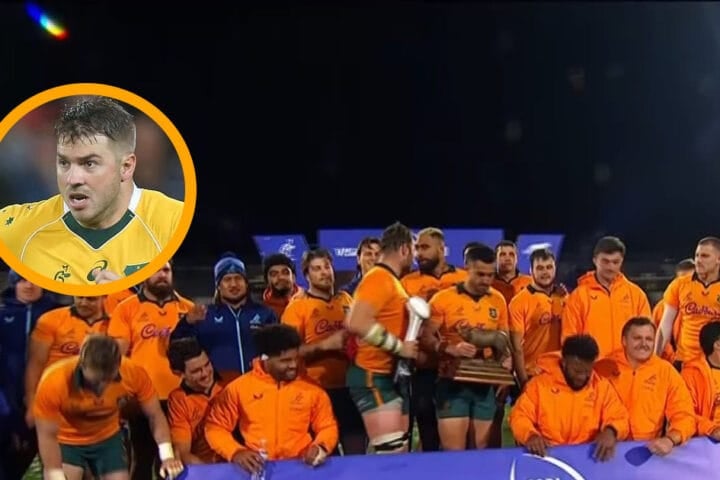
Giteau, 103 Tests at ten and twelve for Australia, thinks those things are connected.
The penalties that slowed the winners down
Argentine reports put the Pumas’ penalty count at 14. On Kick Offs and Kick Ons on Monday, Giteau’s number for Australia was nine, and his point was not about discipline at all.
“What I found really interesting is the amount of penalties we received. In terms of Argentina’s ill discipline, it allowed us to really control the game. But it also slowed us down a lot, because obviously with the penalties we’d go back to set piece.”
That inverts what every broadcast graphic tells you a penalty is worth. A penalty in the opposition half is not a reward. It is a choice, and one of the options carries a cost nobody puts on screen.
Kick to the corner and you buy forty metres. You also buy the defence a reset. Their line straightens. Their forwards get off the floor. Their loosehead gets his breath back. Then the lineout has thirty seconds to form, the maul has to be set, and a game that was being played at a sprint is now being played at a walk, on your terms, with all fifteen of them ready.
Australia did that over and over in Jujuy. It looked like control, and it was. It just was not tries. Kiss has a different word for it, and it comes later.
The one try that proves it
Argentina scored three, and the middle one is the whole argument.
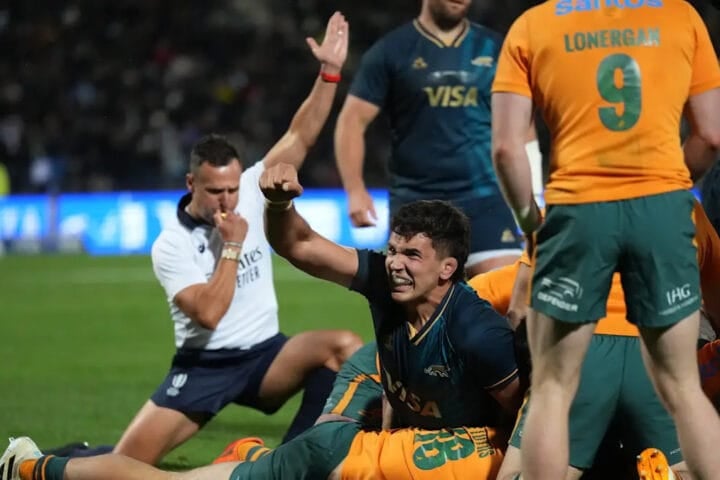
Harry Potter was in the sin bin from the 25th minute for a deliberate knock-down. Twelve minutes later, with the Wallabies a man short, Argentina won a short-arm free kick near the line. Joaquín Moro did not wait for a scrum or a lineout. Quick tap, one carry, try. The rugby.com.au live blog recorded it as the No 8 going “quickly once again”, which is the telling phrase: he had tried it before and been stopped. He kept trying it because it worked.
Giteau’s version:
“The moments that we come unstuck, when Argentina scored points, was when they played quickly.”
Giteau made it sweeping and the tape is more mixed: Gerónimo Prisciantelli’s opener was a set play off a Rodrigo Isgró line, and Boris Wenger’s third was patient and close-range. But Moro’s was pure speed, it came in the window when Australia were most vulnerable, and it dragged Argentina back into a match they had been losing 12–0.
Then there is the try Australia nearly scored the same way. In the 72nd minute Tate McDermott took a short-arm quickly himself, went for the line, and was held up by a wall of Pumas. The one time the Wallabies chose the tap over the corner in a tight game, they were a metre from settling it.
Kiss agrees about the problem. He does not agree about the fix.
Kiss saw the same match and diagnosed the same thing from the opposite side.
“They really controlled the ruck well, didn’t they?” he said afterwards. “The speed of ball and their defence loaded up on us.” Then: “I thought we didn’t manage that as well as we could have. We were a little bit too much ball in their area. We could have been more compact, try and penetrate, collapse their defence a little bit more.”
More compact. Not a coach asking for tempo, then. A coach asking for tighter carries and shorter passes, and fewer wide plays that give a loaded defence something to hit. He said as much again in the same press conference: Australia “offered too many opportunities” with “some options that just gave them field position and gave them the ball freely.”
So Giteau says faster. Kiss says tighter. Both are looking at the same 35 minutes.
They are describing two different parts of the pitch. Between the 22s, Kiss is right: Argentina’s defence was loaded, the ball was slow, and wide play into a set line handed the Pumas ten entries into the Australian 22. Pablo Matera, the Argentina captain, said his side lost “six or seven balls” at the breakdown, “almost a record for us”, which is the flip side of the same coin. The breakdown was where Australia won it.
Inside the 22, Giteau is right. The pick-and-go worked. The set piece worked. What did not work was the moment the ball went wide with the line still organised, which is why Jeremy Williams dropped one over the line in the 71st minute and McDermott was held up in the 72nd. Kiss knows it. “It’s something we’ve worked on for sure,” he said of the finishing. “Jonny Fisher and John Ulugia have done a lot of work in that area.”
Wallabies Argentina second Test: the same question, faster
Argentina have not won a Test in Mendoza since they beat South Africa 32–19 there in 2018. Australia have won their last two visits, 37–20 under Michael Cheika in 2017 and 41–26 under Dave Rennie in 2022. The Puma Trophy is on the line on Saturday, and AAP reported this week that no Australian side has won two Tests in Argentina on the same tour.
None of that is comfort. Two years ago in Santa Fe the Wallabies conceded 67 points, the heaviest defeat in their history. Ewen McKenzie said before this series that Argentina can match Australia physically in ways Japan never could, and Argentine reports have the week’s training in Mendoza built around one word, urgency, with Prisciantelli reported as saying Argentina were not aggressive enough at the ruck and let Australia slow them down. The Pumas will play faster in Mendoza. They have said so.
Which means the Wallabies get the same decision again, at a higher speed. And a more direct Wallabies was the whole point of Kiss’s first selection, so he has already answered half of it.
Watch the first penalty Australia win inside the Argentine 22 on Saturday. Corner, or tap. Everything Giteau argued on Monday is contained in that one decision, and so is everything Kiss said he wants to fix.
Frequently asked
When is the Wallabies v Argentina second Test? Saturday 5 September at Estadio Malvinas Argentinas, Mendoza, 18:00 local, which is 7am AEST on Sunday morning. The Puma Trophy is decided on it.
What is the Wallabies’ record in Mendoza? Two wins from their last two visits: 37–20 under Michael Cheika in 2017 and 41–26 under Dave Rennie in 2022. Argentina have not won a Test there since beating South Africa 32–19 in 2018.
Why did the Wallabies stop scoring in Jujuy? Three tries in the first twenty minutes, one in the next sixty. Giteau’s reading is that every penalty won sent Australia back to a set piece and let Argentina’s defence reset. Kiss’s is that the ball was slow and the attack went wide too early. Both are pointing at the same 35 minutes between McReight’s try and Hooper’s.

Two ways to see Jujuy. Either Australia controlled a Test on the road with 62 per cent of the ball and a penalty count in their favour, and the flat half-hour was the price of doing it properly. Or they won it in twenty minutes and spent the next hour handing Argentina the shape to make a game of it. Corner or tap on Saturday settles which. Pick one below, before Kiss does.



Comments
No one has weighed in yet.
Be the first - what did you make of it?