



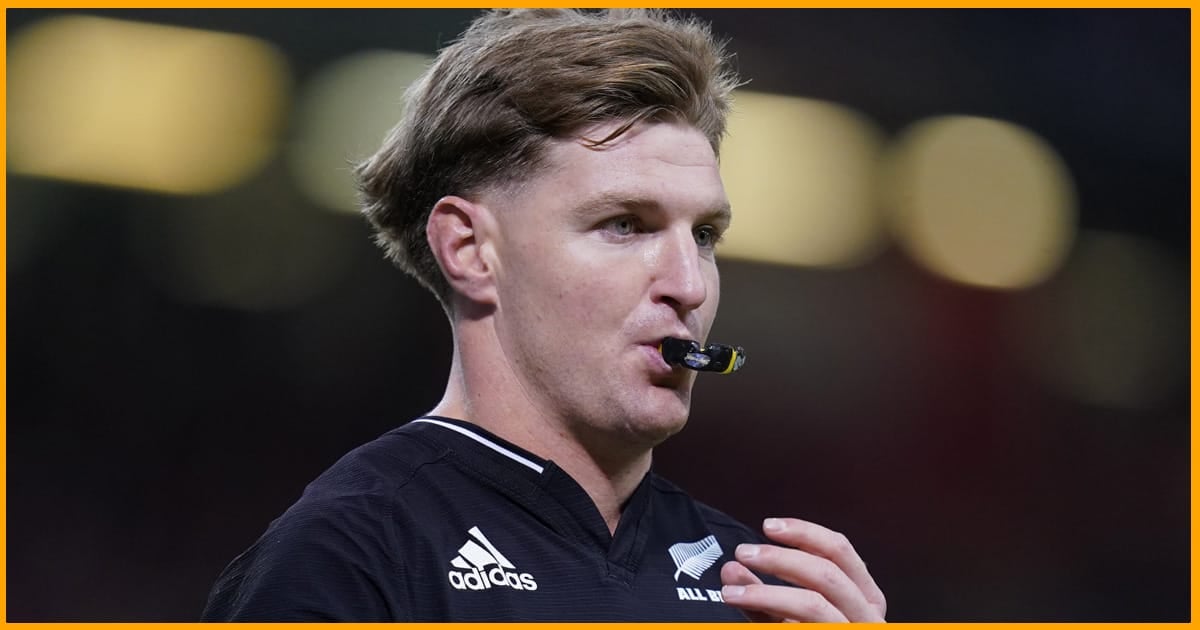
The one back who has started every Test under Dave Rennie went on Newstalk ZB and re-scored the only Test the All Blacks have won on this tour. The Opta numbers from that night say he is right, which is why “we’re not far away” is not the losing-side cliché it sounds like.
Every side 2-1 down in a series says it is not far away. Very few of them then hand you the evidence against their own best result.
South Africa lead Rugby’s Greatest Rivalry 2-1 with one Test to play, and both camps had already called Baltimore the decider.
“What was it 33-16 in that first test at Ellis Park and we felt like South Africa probably had the wood over us for about 55 minutes.”
Those are the words of Jordie Barrett, on the Mike Hosking Breakfast on Newstalk ZB on Thursday morning, talking about a Test his team won by 17 points.
So is he making excuses, or is he the only man in either camp describing this series accurately? The comments are open.
What Jordie Barrett actually claimed, and it is bigger than it sounds
Barrett did not stop at the 55 minutes. He finished the thought.
“Couple of moments they get a yellow card and we win by two or three tries and we walk away from that test match all happy and we probably felt like we played better in game two and lost by seven points.”
Read that twice. The one back who has started every Test under Rennie is saying the 33-16 was built on two cards, that the performance underneath it was worse than the one that lost in Cape Town, and that the true gap between these sides has never once matched the scoreboard.
He is describing a series of three near-identical Tests wearing three misleading scorelines.
The Ellis Park numbers agree with him, line for line
This is the part the radio interview left on the table.
South Africa had 61 per cent of the territory at Ellis Park. They led 13-12 at half-time. They won the scrum penalty count 5-1. They went into the New Zealand 22 ten times.
They scored once.
Opta has tracked points per 22 entry since 2020. South Africa’s 2026 season average is 5.5 points every time they get there. At Ellis Park they returned 0.7. New Zealand made nine entries and returned 3.6 each.
| Ellis Park, 22 August | South Africa | New Zealand |
|---|---|---|
| Territory | 61% | 39% |
| Half-time | 13 | 12 |
| Scrum penalties | 5 | 1 |
| Entries into the 22 | 10 | 9 |
| Points per entry | 0.7 | 3.6 |
| Final score | 16 | 33 |
Source: Opta via RugbyPass, 22 August 2026.
Every column except the last one is a South African win. Barrett’s 55 minutes is sitting in that table.
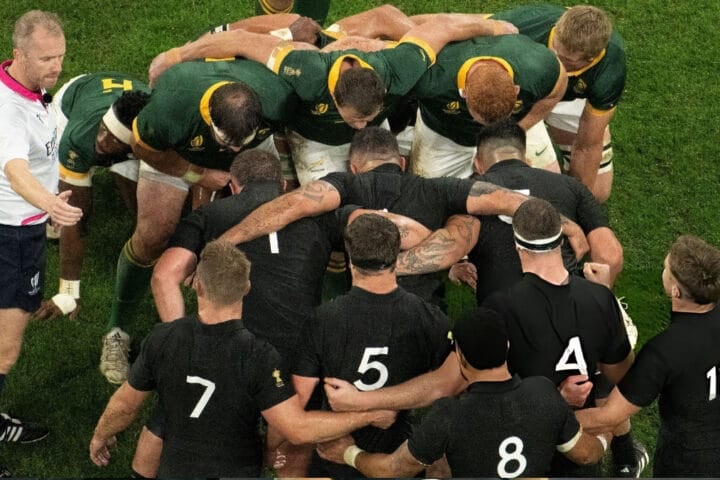
The two minutes that turned a close Test into a 17-point one
Marco van Staden and Cobus Reinach were both binned in the final quarter, inside a minute of each other. South Africa finished with 13 men and lost the second half 21-3. Two of New Zealand’s five tries came after the cards.
This is the mechanism, and it is worth understanding rather than filing under bad luck.

A yellow card does not create points on its own. It removes a defender from a defensive line that is already organised, which is exactly the condition South Africa had imposed for an hour — arriving early, set, letting New Zealand run into a wall. Take one man out and the wall has to choose: fold in and concede the edge, or hold the width and concede the seam.
South Africa had spent 55 minutes making that decision easy and correct. For fourteen minutes they could not.
New Zealand’s points per entry did not climb because their attack suddenly found something. It climbed because the defence in front of it stopped being able to cover both options at once.
Now the case against him, because there is one
If every Test in this series has been close, South Africa have won two of the close ones. It is not an accident, and it is the part Barrett skips.
Look at how Cape Town was actually won. South Africa led 24-14 at half-time and 30-14 just after the hour. They did not score a try after the 37th minute. Cheslin Kolbe kicked three conversions and four penalties, 18 points, and the game was closed out with the boot while New Zealand chased.
The final margin was seven. The Test was never in doubt after 50 minutes.
Soweto ran the same way. The penalty count there was 12-11, almost level, and South Africa still won by five.
So the honest reading is this. Barrett is right that New Zealand have never been outplayed for 80 minutes in this series. He is also describing a side that has needed two yellow cards to convert one of those nights into a win, against a side that converts them without help.
Close is not the same as level. South Africa keep proving the difference.
Why he refuses to treat Baltimore as an exhibition
Asked whether a Test played outside South Africa should count towards the series at all, Barrett did not entertain it.
“Certainly not. Like this Greatest Rivalry [series] was always a four-game series … we’ve got an opportunity to go two-all against a team who’s been well established back-to-back world champions.”
Barrett’s framing is narrower and more useful: a drawn series against back-to-back world champions, away from home, with a squad that has been together a matter of months.
The squad that plays it is thinner than the one that started the tour. New Zealand lost Ardie Savea, whose shoulder went in the first half in Soweto, stand-in captain Luke Jacobson, and Barrett’s midfield partner Quinn Tupaea. South Africa made two backline changes and are without Kolbe. Dave Rennie names his side on Friday, with Barrett among the candidates to captain it.
He has started every Test under Rennie. Barrett had already told the South African leg he was physically sore, and a former All Blacks halfback calls him the best player in the world. He also described the last three weeks as the most enjoyable Tests an All Black can play.
“As hard as the last three weeks have been for me, I’ve absolutely loved it.”

The tell to watch in Baltimore
Forget territory. Forget possession. Both have lied in this series three times out of three.
Count 22 entries, and count what comes out of them.
At Ellis Park South Africa got there ten times for seven points. In Cape Town four entries were enough for 33. That is the whole rivalry in two lines: one side manufactures pressure and cannot bank it, the other banks everything it gets.
If New Zealand are as close as Barrett says, it will show up as points per entry above three without needing anybody sent to the bin. If South Africa are as far ahead as the table says, they will win it with fewer visits than New Zealand and more points from them.
Frequently asked
Did the All Blacks deserve to win the first Test 33-16?
On the scoreboard, comfortably. On the underlying numbers, less so. South Africa had 61 per cent of the territory, led 13-12 at half-time and won the scrum penalty count 5-1, but took 0.7 points from each of ten visits to the New Zealand 22 against a season average of 5.5. Two of New Zealand’s five tries came after yellow cards to Marco van Staden and Cobus Reinach in the final quarter.
What did Jordie Barrett say about the Baltimore Test?
He rejected the idea that it does not count, calling Rugby’s Greatest Rivalry a four-game series from the start, and framed the fourth Test as a chance to finish two-all against back-to-back world champions.
Who is missing for the fourth Test?
New Zealand are without Ardie Savea, Luke Jacobson and Quinn Tupaea, all injured in Soweto. South Africa are without Cheslin Kolbe, whose jaw broke after nine minutes in Soweto, and made two backline changes from the third Test.
Who captains the All Blacks in Baltimore?
Dave Rennie names his squad on Friday. Barrett is in the running, along with Codie Taylor and Patrick Tuipulotu.
Where does this sit in the series?
South Africa lead 2-1. Win in Baltimore and they take it 3-1; lose and it finishes 2-2. Here is every fixture, result and kick-off time in the series.
Your turn
So which is it. Is Jordie Barrett the only honest man in either camp, describing three tight Tests that three scorelines misrepresented — or is “we’re not far away” what a side says when it has been beaten twice by an opponent that simply knows how to finish?
One of those sides has now won the close ones twice. Settle it below.







Comments
No one has weighed in yet.
Be the first - what did you make of it?