Same carries, 154 metres apart after contact. On Talking Boks the morning after Baltimore, Nick Mallett called it the number Dave Rennie has to change before a World Cup quarter-final, and was harder on the Springboks than on New Zealand.
South Africa carried the ball 142 times in Baltimore. New Zealand carried it 137 times.
One side made 523 metres after contact. The other made 369. Same work, 154 metres apart. On Sunday morning a former Springboks head coach said that number is the one Dave Rennie has to change before the sides meet in a World Cup knockout.
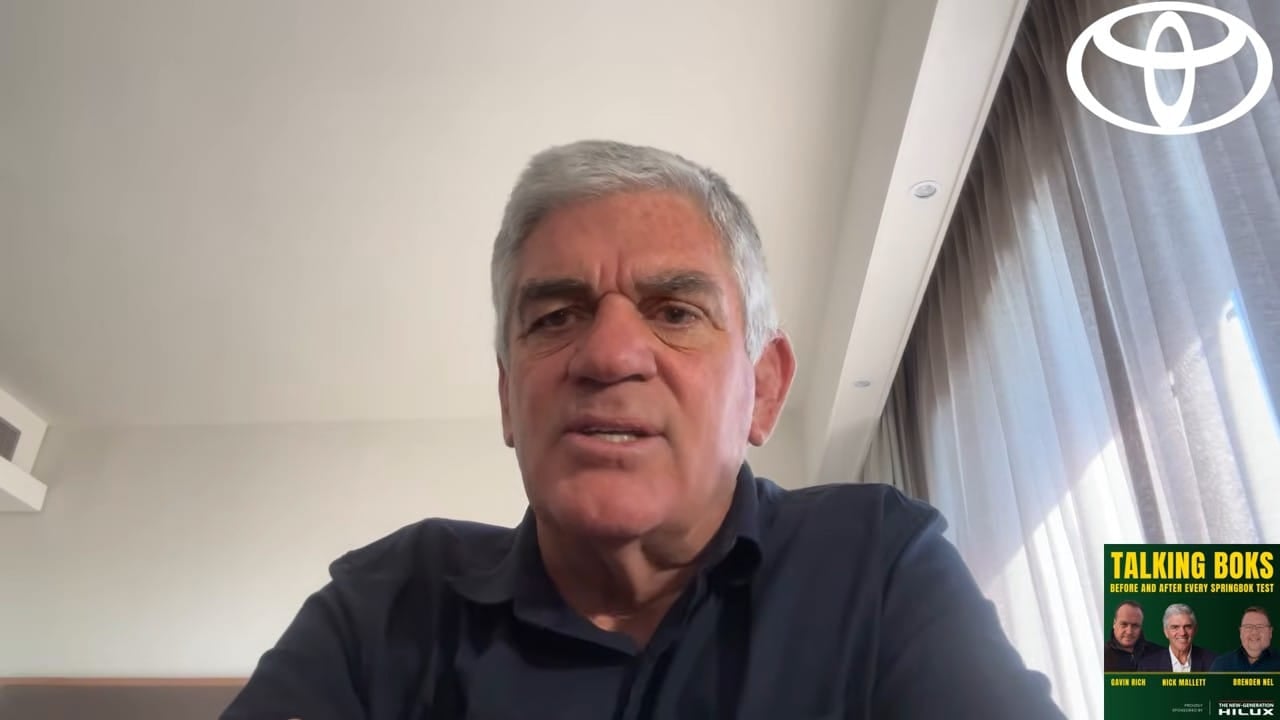
Nick Mallett coached the Springboks from 1997 to 2000 and won 17 Tests in a row. He said it on Talking Boks, Brenden Nel’s show with Mallett and the writer Gavin Rich, published on Sunday 13 September, the morning after the 43-28 win took Rugby’s Greatest Rivalry 3-1.
Then the line that will travel: “If they don’t have players [who] can stop our momentum, they won’t win that quarter-final against us.” A former Springboks coach has set New Zealand a World Cup exam a year out. Is the gap really in the collision, or is he reading one night’s stat sheet? Say which below.
Nick Mallett says movement rugby will not beat the Springboks
“I don’t think you’re going to beat South Africa just by playing movement rugby. I think he understands that they’re going to have to front up physically, which I didn’t think they did. Those post-contact metres are pretty critical.”
The “he” is Rennie, and Mallett had just spent a minute being generous to him: 11 Tests in the job against Rassie Erasmus’s 100, and time to bed the side down. The generosity stops at the collision.
“When you’re suddenly getting a Wiese making 10 metres, when none of their players… their player will make 20 or 30 if [he] makes a line break, but any ball carrier from their team into contact was smashed immediately, whereas our guys kept on getting momentum. Even if it was two metres or one metre or five metres, we kept on getting momentum.”
Post-contact metres are the ground a carrier makes after the tackler arrives. A line break inflates the total in one carry. A metre on every carry builds it without a clean break. That second kind wins the night. The ruck forms a metre further forward each time, and the defence sets a metre further back.
You can see it without a stat sheet. Watch where the tackle finishes against where the carrier was hit. In Baltimore the carrier in green finished, on average, a metre further on than the carrier in black: 3.7 metres after contact against 2.7.
Daily Maverick’s Craig Ray put the figures at 523 metres after contact from 142 carries for South Africa and 369 from 137 for New Zealand. Line breaks were 11 to 8.
Jasper Wiese was the carrier Mallett named. The better line went to Damian de Allende: “Whenever we were going down a blind alley, pass it to him and he would get us on the front foot.” The centre nobody talks about as one of the best in the world, described by a man who picked centres for a living.
Same carries, 154 metres apart
Rich covered every match of the tour, franchise games included, and he put the power gap in blunter terms.
“That is their big worry, is that they’ve got to front the Boks physically, and at the moment they’re not really showing signs of doing that. They come [a] very poor second when it comes to the power game.”
He was not sneering. Minutes earlier he had called the 32-phase try that put Will Jordan over on 38 something no other side could produce: “I don’t think there is a team in the world that can replicate that kind of sublime skill level.” Thirty-two phases for one try is the point. The ground came a phase at a time because it was not coming a carry at a time.
Rennie looked at the same stat sheet and called it an even game. Carries and turnovers were even. Metres after contact were not, and that is the column he left out.
New Zealand outscored South Africa across the first three Tests and still lost two of them, and finished the series ahead on tries, 17-14, and behind on points, 121-111.
The Springboks wasted more than they took
Then he turned on his own side, and this is the part of the episode that should worry Erasmus more than anything Rennie says.
“If we have 12 entrances into the opposition 22, we should be scoring six tries out of those 12. And to score one in that first Test was unacceptable. So I would always say, you know, here Siya said we played so well, we created all these opportunities, but we didn’t play well, because we didn’t take the opportunities.”
The first Test is the evidence. Ellis Park: eleven visits to the New Zealand 22 and one try, a 33-16 defeat, five tries to one against. Siya Kolisi, who missed that Test, was asked after Soweto whether the win there was the best rugby the side had played, and disagreed.
“I do disagree, it’s not the best… But the first game I thought we played better than we did these past two games, we just didn’t convert.”
He said that at the press conference at FNB Stadium on Saturday 5 September. For Mallett, “we just didn’t convert” is the charge itself. His target: “to take, say, 50% of the opportunities we make instead of 25%, which was the situation possibly in that first Test and second Test.” And the fix is, in his words, “an execution improvement. It’s the ability to take the right decision at the right time.”
Over the whole series, Rich said, “the Boks probably have wasted more scoring opportunities than the All Blacks have.” The winners left more on the table than the losers. Nobody in Baltimore was arguing.
Read also: the Springboks marked on the same 80 minutes in Baltimore, where a 9.5 went to a scrum-half making his first start of the series.
“It’s very dangerous to move away from your core strengths”
Eleven line breaks in Baltimore had Rich repeating the question doing the rounds in South Africa: had “Tony ball”, the shape of the attack coach Tony Brown, been shelved at all? Brown is the man New Zealand Rugby has already signed as an All Blacks assistant from 2028, so the question travels. Mallett did not celebrate it.
“It’s very dangerous to move away from your core strengths, and for us to become a New Zealand style… I know we want movement, which is fine, but I like us being direct, even with the backs. We’ve got enough backline players, like Kolbe, like Arendse, like Damian Willemse, like Sacha, like Grant Williams when he comes on, who’ve got brilliant feet and beat people and find space with agility and New Zealand-esque type skill. But New Zealand don’t have players who carry like we do. They don’t have your Damian de Allendes, your Kriels, your Siya Kolisis…”
Read the quote against the numbers. The 11 line breaks came from the feet he lists. The 523 metres came from the carriers he lists. His fear is that chasing the first costs the second. New Zealand have a back three who can do what Kurt-Lee Arendse did on 72. What they do not have, on Mallett’s reading, is an inside centre who puts his side on the front foot when the move has died, and three defeats in four say he is right.
“They won’t win that quarter-final against us”
The sentence at the top of this piece came at the end of his answer on post-contact metres, and it is the whole argument in 17 words.
A named call, from a man whose record in this fixture is on the wall. Rennie’s is shorter: 11 Tests, seven wins and four defeats, every one of the four against South Africa. Erasmus, for his part, would not call the Springboks the better team after the fourth of them.
Mallett would not either, quite. He is a coach, and coaches do not celebrate in September.
“We’re in a very, very good position at the moment, but a year is a long time. It really is a long time. I just want to preface what I’m saying by reminding everyone that Rassie and this coaching staff have had this team for 100 Test matches.”
Rich named the cavalry New Zealand are waiting on, Brodie Retallick and Scott Barrett, and then the gap in it: “I don’t know if there’s any front row people that they can get back.” Locks change a lineout. They do not change what happens to a wing who takes the ball into André Esterhuizen.
A metre after contact, every carry, for 80 minutes. New Zealand have 12 months, two Bledisloe Tests and a Nations Championship to find the men who stop it. A former Springboks coach has told them, on air, what happens if they do not.
Read next:
– Mallett on the midfield New Zealand do not have: the morning after Soweto he rated de Allende and Kriel above de Villiers and Fourie, and the reason was what Kriel never does.
– Mike Blair would rather waste a chance than lose the ball. The All Blacks attack coach explained the trade-off in Baltimore week. Mallett has just explained its cost.
– The fly-half who has not finished a Test at 10 in this series, and went four Tests without a try.
Frequently asked
What did Nick Mallett say about the All Blacks after Baltimore?
That they will not beat South Africa “just by playing movement rugby”, that every New Zealand carrier “into contact was smashed immediately”, and that without players who can stop the Springboks’ momentum “they won’t win that quarter-final”. He said it on Talking Boks on Sunday 13 September.
What are post-contact metres in rugby?
The distance a ball carrier gains after the first tackler makes contact. In Baltimore, Daily Maverick had South Africa at 523 post-contact metres from 142 carries and New Zealand at 369 from 137.
What is Dave Rennie’s record as All Blacks head coach?
Eleven Tests, seven wins and four defeats, per the NZ Herald’s 2026 results page. All four defeats came against South Africa in Rugby’s Greatest Rivalry. The Bledisloe Cup against Australia is next, in October.
Your turn: is the gap in the collision, or in one night’s stat sheet?
Two ways to read Mallett. Either New Zealand’s problem is personnel, they need carriers who make a metre after contact and tacklers who stop one, and no amount of shape fixes that before 2027. Or one Test’s post-contact column is being asked to carry too much, and the 32-phase try is the truer forecast of what this All Blacks side becomes. Which one did the series prove? Settle it below.