


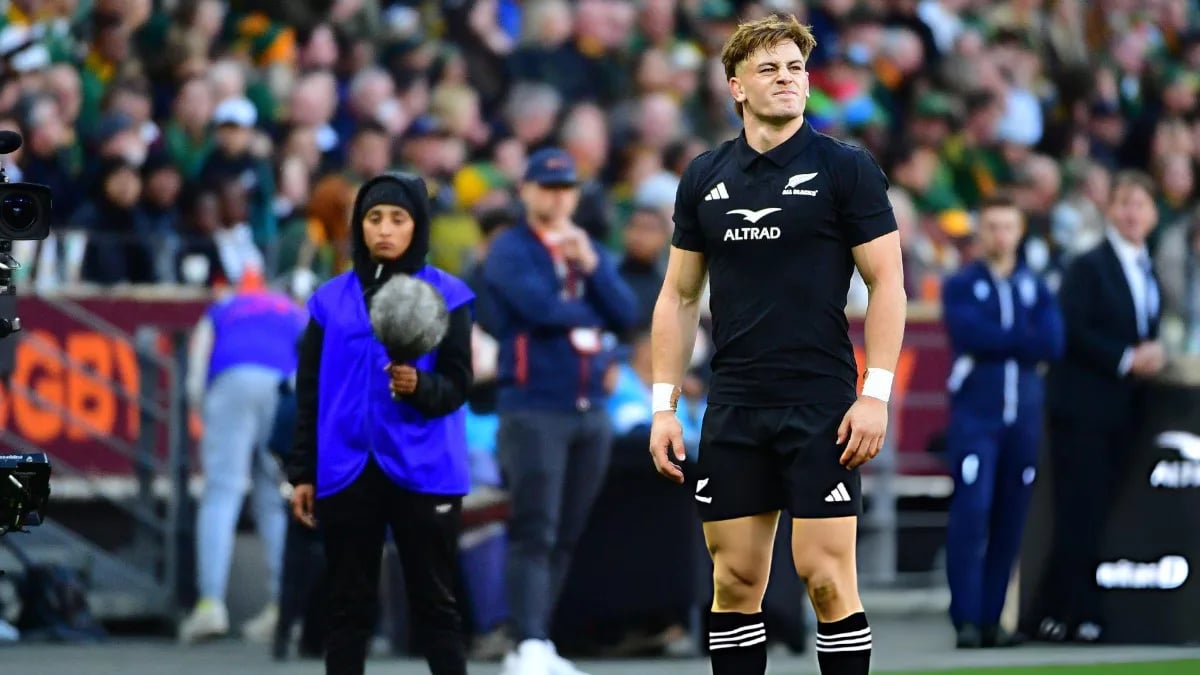
New Zealand were the better side for twenty minutes in Soweto and lost 29-24. Watched back, the Test turns on five moments: two belong to a wing, two to a fly-half, and the last one to the whole squad.
The All Blacks lost the third Test 29-24 to the Springboks at FNB Stadium on Saturday, and the series stands 2-1 to South Africa with one Test left in Baltimore.
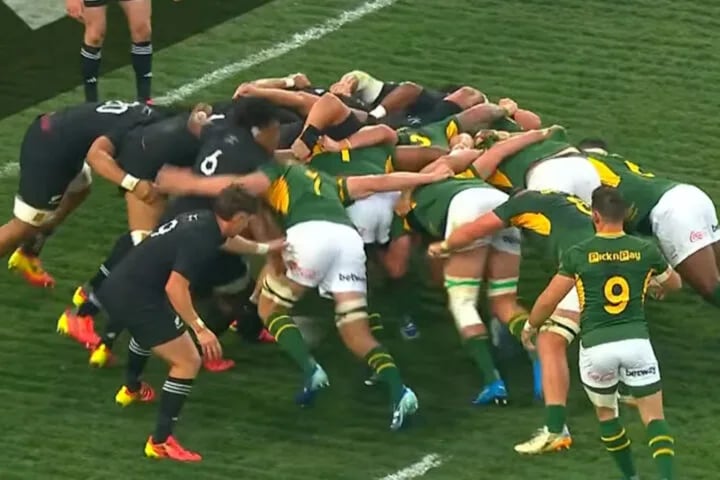
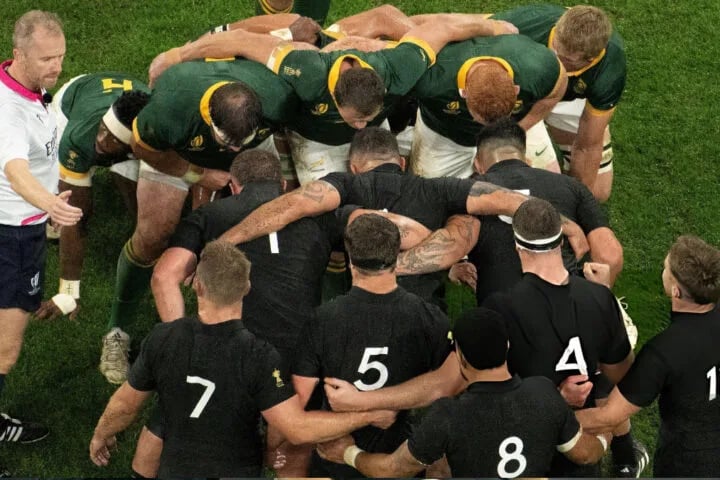
Live, it felt like a match decided by a scrum. New Zealand fed 11 of them and came away with a penalty try and four penalties against, and that is what the stadium remembers.
Watched back the next morning, with the noise gone and the clock in the corner of the screen, it is a different Test. The question of why the All Blacks lost has five answers. Four of them have a name attached. The fifth does not, and it is the one nobody in the New Zealand camp will want to read.
If you think the scrum is the whole story, the comments are at the bottom. Read the fifth one first.
The twenty minutes that were going right. For the opening quarter New Zealand were the better team. The Springboks did what they always do and went looking for the collision, and the All Blacks absorbed it. Peter Lakai stole the ball off an isolated Ruan Nortjé on four minutes. Will Jordan ran past six defenders on seven. Ardie Savea scored on 11 while Sacha Feinberg-Mngomezulu sat in the sin bin. Then South Africa won three penalties in three minutes, took a lineout to the corner, and came away with nothing.
Twenty minutes of Springboks pressure. No points. The first mistake lands there.
1. One tackle, and twenty minutes of defending were gone (22 minutes)
New Zealand lost their own lineout ball, Jesse Kriel ran through an edge on the right, Manie Libbok’s long pass found Ethan Hooker on the left, and the ball came back infield to Damian de Allende with Leroy Carter in front of him.
De Allende went past him one-on-one. The pass to Kurt-Lee Arendse was the easy part.
A wing defending the edge has one job when the ball comes back inside: hold his width and make the tackle on the man in front of him, because the cover behind him is already committed to the far side. Carter went for the hit and did not make it, and twenty minutes of holding went in one movement.
New Zealand answered inside four minutes, and that answer was the best thing they did all night. Libbok failed to find touch, Ruben Love started the counter, Carter broke down the left, and Savea scored his second. 12-5, and the momentum that South Africa had spent twenty minutes trying to build was New Zealand’s again.
Which is why the second mistake cost so much.
2. Love’s yellow card, a metre from the line (36 minutes)
Cobus Reinach tackled Asafo Aumua on halfway and ripped the ball free. Jasper Wiese ran through a wall, Ox Nché took the offload around his laces, and Libbok stepped inside three times to a metre short of the line. Love went in to slow the ball down and Nika Amashukeli sent him to the bin.
The scrum conceded the penalty try, not the card. But the penalty that produced the scrum was Love’s, and it was given away in the one place on the field where slowing the ball buys a fly-half nothing. South Africa were a metre out with a pack that had already won a scrum penalty on 14 minutes through Wilco Louw’s shove. Hand that pack a five-metre scrum and it is a seven-point machine.

New Zealand went in at 12-12 instead of 12-5, and started the second half without their 10 for five minutes. The first scrum of that half went down and cost another penalty.

3. Seven points off the tee, in a Test lost by five
Love’s conversion of Savea’s second try went across the face on 26 minutes. His penalty from the left of the posts on 53 was a kick the Guardian’s live blog said “should have been slotted”. His conversion of Jordan’s try on 56 came from the touchline and did not come round.
Two conversions and a penalty. Seven points. New Zealand lost by five.
The arithmetic is worse than the total. Land the penalty on 53 and New Zealand lead 15-12 before Jordan scores. Land that conversion and it is 22-12. Kriel’s try then brings South Africa to 19-22 rather than 19-17 in front, and the Springboks go into the last quarter chasing instead of leading. Kick all three, and the same sequence of tries ends 29-29 in Soweto with the series still level.
He is ten Tests into a career at fly-half and he found the corner every time he kicked for it. The kicks at goal are the part that is not there yet.
4. Two minutes after Jordan’s try, Carter again (57 minutes)
Jordan’s try on 56 was New Zealand at their best: a grubber from the opposite wing, Carter running onto it and waiting in the tackle, Jordan arriving to score. 17-12, and for the first time since the penalty try New Zealand had the match where they wanted it.
What a side needs at that moment is five minutes without conceding. Kick long, defend the restart, make the Springboks earn the next entry.
South Africa won the restart, went down the short side, then through the hands to the right. Feinberg-Mngomezulu fired a long pass to Libbok, Libbok fired one to Kriel, and Carter rushed up out of the line and missed. Kriel ran in from 22 metres. Feinberg-Mngomezulu converted, and South Africa led for the first time all night, 19-17, inside two minutes of trailing by five.
A wing who leaves the defensive line early to make a hit has to make it, because the space he has left behind him is the width of the pitch. Carter’s break made Savea’s second try and his patience made Jordan’s, and both Springboks tries from open play came off a one-on-one he lost. Carter’s mark in the All Blacks ratings is the one that had to be defended.
5. The last twenty minutes, and nobody’s name on them
New Zealand lost the first hour at Ellis Park and won the Test anyway. In Cape Town they scored 12 points to three from the hour, and the Springboks bench had stopped winning the last quarter. Two Tests running, the final twenty minutes belonged to the side in black.
On Saturday they belonged to South Africa, ten points to seven, and the seven came after the hooter.
Malcolm Marx’s breakdown penalty on 61. Fletcher Newell’s scrum penalty on 65, which became the 20-metre maul and Marx’s try. Fabian Holland’s side entry in front of the posts, Newell offside again, and a clearance that missed touch with the match still alive. None of those is a missed tackle or a missed kick. They are the decisions of players whose legs were still fine and whose judgement had gone.
Sixty-five minutes into a Test like this the legs still work and the judgement does not, and it was all over the New Zealand pack. Savea had gone on 31 with his arm hanging. Quinn Tupaea needed treatment on 43. The two starting props were replaced on 45 and the scrum kept conceding. South Africa used all eight replacements, made 150 tackles to 106, and had 43 per cent of the ball. They did not need it. They had the collisions, and after an hour of them the All Blacks could not keep pace with what the collisions cost.
That is the mistake without a name. The other four were survivable at 17-12 up. This one was not.

Why the All Blacks lost, and what Baltimore needs
New Zealand must win the fourth Test on Saturday 12 September to square the series 2-2. A draw hands it to South Africa.
Four of the five are fixable in a week. A wing can be told to hold his width. A fly-half can kick a hundred balls at a post. The fifth is the harder one, because the Springboks will bring the same collisions to Baltimore and the same bench to finish them, and the question for Dave Rennie is not whether his side can play the first hour. They have done that three times. It is whether they can survive the last twenty.
Frequently asked
Why did the All Blacks lose to the Springboks at FNB Stadium?
Why the All Blacks lost comes down to five moments: Leroy Carter’s missed one-on-one tackle before Kurt-Lee Arendse’s try on 22 minutes, Ruben Love’s yellow card a metre from his own line on 36 that led to a penalty try, Love’s three missed kicks at goal worth seven points, Carter’s second missed tackle for Jesse Kriel’s try on 57, and a last twenty minutes in which New Zealand conceded three penalties and a 20-metre maul try.
How many points did Ruben Love miss?
Seven. He missed the conversion of Ardie Savea’s second try on 26 minutes, a penalty on 53, and the conversion of Will Jordan’s try on 56. New Zealand lost by five.
What do the All Blacks need in Baltimore?
A win. South Africa lead the series 2-1, so a draw in the fourth Test on Saturday 12 September gives them the series. New Zealand must win to level it at 2-2.

Your turn
Take one of the five away and New Zealand win in Soweto. Which one? Most of the comments will say Love’s boot. The rewatch says Love’s boot was the fourth-biggest mistake of the night, not the first, and the last twenty minutes were the one New Zealand could not have survived. Make the case for a different one, with a minute attached.





2 comments
for mine this breakdown is accurate and concise
would add 2 other observations;
1- giving up 30+ kilos in scrum mass gave NZ no room to manoeuvre-inaccuracy or deviation from their process was severely punished
2- more fluid substitution philosophy
NZ historically make changes in the second half only with little to no variation
a pack reshuffle late in the first half may have addressed the obvious scrum issues..maybe not
wisdom of hindsight and all.
enjoy your analysis!
Love's yellow was a mistake by the ref. Replays show that when he called Love offside the Ref had his back to Love, who had accelerated off the Goal Line, and that the ref simply assumed an offside where none existed