


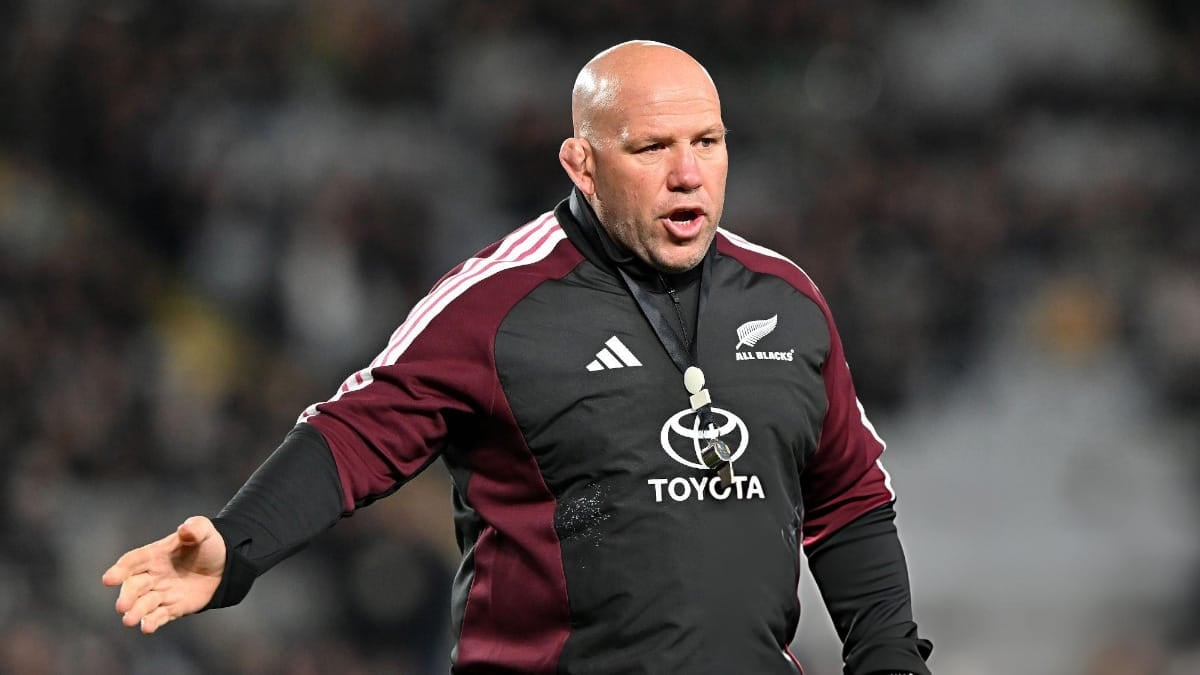
South Africa’s first two tries in Cape Town came off a lineout maul. The next morning, All Blacks forwards coach Jason Ryan explained why, without once mentioning the referee.
Two seconds.
That’s what the All Blacks forwards coach says separates the pack that won at Ellis Park from the pack that got driven backwards in Cape Town. Not the Springbok scrum his head coach spent the whole build-up arguing about. Two forwards, one lineout, and an All Blacks maul defence that arrived late.
Jason Ryan was handed a free shot at the referee on Sunday morning and did not take it. What he gave instead was a number, and a window about a second and a half wide that you can actually see on television if you know where to look. Where to look comes later. First, the two minutes that decided the Test.
The first two minutes told them what the night would be
South Africa kicked off. The All Blacks came under pressure immediately, gave away a penalty, and watched it go straight into the corner.
Then the lineout. Deon Fourie found his jumper, the maul formed, and it marched New Zealand roughly fifteen metres backwards and deep into the 22. Jesse Kriel scored inside the opening two minutes.
New Zealand never led. Not once, in a Test they finished having scored four tries to three.
It finished 33-26 on Saturday 29 August, levelling Rugby’s Greatest Rivalry at 1-1. The next morning, at an All Blacks press conference in Cape Town, Ryan was asked why the maul he was hired to fix in 2022 had been rolled through again.
He did not mention Angus Gardner once.
“I thought we didn’t quite start the Test match with the intensity that we wanted to. I think right from that first kickoff, they put us under pressure.”
Which is a coach declining to make it complicated. The Springboks did the most obvious thing in their catalogue, first phase, first lineout, and it worked. Then it worked again for Damian de Allende. A team does not get to be surprised by that twice, and two of the five moments that decided Cape Town were the All Blacks’ own lineout.
Two seconds, and a corner they never left
The question was put to Ryan directly. He arrived in 2022 and the rolling maul stopped being a problem almost overnight. Saturday, it was a problem again. Was he worried?
“We missed a couple of roles in that lineout, and that really cost us, and then they got momentum. We were like two seconds too late in two areas, and then they got a bit of a corner, and then they kept it in there. Once a maul starts, it’s hard to stop it. So we needed to be a little bit earlier there.”
None of that is what a losing coach normally offers you.
He does not say South Africa were stronger. He does not say the referee let the maul stay up. He says two of his forwards did not do the job they were given, that the pack arrived about two seconds after it needed to, and then he explains the consequence in the plainest available English. Once it starts you cannot stop it, and once they have the corner they simply keep it there.
Nobody in this series has been that exact about a mistake. Ardie Savea had already named it on the night, and he did not say the scrum either.
Two press conferences, one morning, and only one camp still angry
At almost exactly the same hour, on the other side of Cape Town, Rassie Erasmus was still furious about the scrum. Asked about New Zealand’s complaint, as reported by 1News, the Springboks coach swore his way through the denial and finished with a question:
“It’s the first time ever in history that people are talking about us walking around, so why would we all of a sudden walk around?”
He asked why six of New Zealand’s early scrums had gone to ground, and told the room not to bring him “that nonsense”.
And meanwhile Ryan, speaking to his own press pack that same morning:
“We’re going to control what we need to. I thought we scrummed really well last night. I really did.”
Then, on where the week’s attention should go:
“So we’ll just concentrate on ourselves the best we can during the week. Remove the referee, remove the opposition, and ask how are we going to be better?”
Put those two men side by side and the argument is over. Dave Rennie had taken the Springbok scrum to World Rugby three days before kick-off, and then the referee they asked for gave them the game they asked for and the walking-around never stopped. The camp that started the fight has quietly dropped it. The camp accused of cheating is the one still shouting.

A forwards coach who believed his scrum had been cheated does not say “I thought we scrummed really well” six days out from a decider. He keeps the pressure where it was working. Ryan moved it onto his own maul, and on the accusation that the All Blacks had been moaning he gave the line of the morning: “It’s a bit of friendly fire, isn’t it?”
At Ellis Park the same pack went too early
The part that turns one bad lineout into a story about a whole series came next, unprompted.
“And then it’s a fine line, because in the last Test we went too early. So we’ll just have to train that a lot better this week.”
Same picture, same opposition, and the exact opposite error seven days apart.
| Test | Venue | Ryan’s own diagnosis |
|---|---|---|
| First Test, Saturday 22 August | Ellis Park | The pack went too early |
| Second Test, Saturday 29 August | DHL Stadium | Two seconds too late, two roles missed |
Source: Jason Ryan, All Blacks press conference, Cape Town, Sunday 30 August.
A pack that goes early gets penalised for closing the gap before the maul legally exists. A pack that goes late gets driven fifteen metres. New Zealand have now been on both sides of that line inside a fortnight, against the one side in world rugby built to punish either.
They did not get shoved off the park in Cape Town. They got there second, which is a different problem and a more fixable one.
Where the All Blacks maul defence actually broke
This is the bit worth taking into Saturday, and almost nobody at home looks for it.
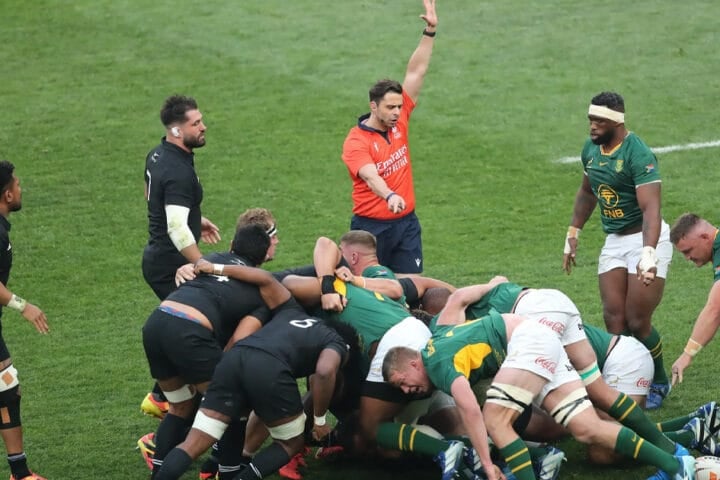
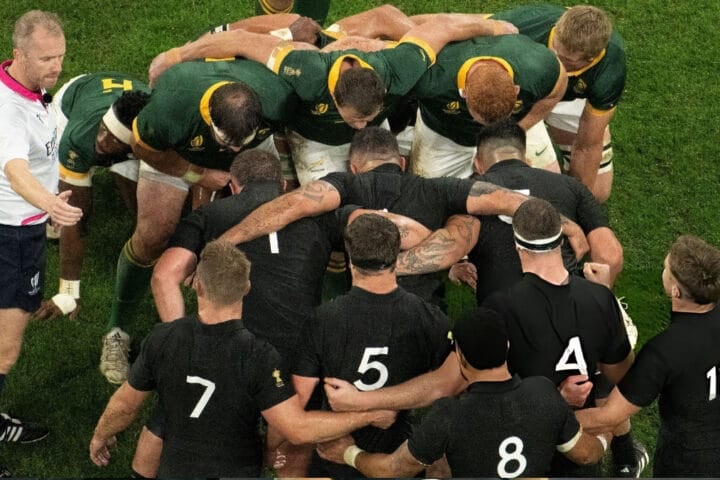
The All Blacks maul defence is not five men pushing. It is a set of jobs, handed out before the throw, that only works if they happen in the right order. One forward attacks the catcher’s landing. Another seals the tail so the drive cannot swing. A third stays square and holds the width, so the ball cannot be shipped to a hooker peeling off the back.
Get one of those wrong and the rest are pushing against a maul that has already formed, which is exactly the thing Ryan says you cannot stop.
The window is small. It opens when the jumper is brought to ground and closes when the second Springbok binds on. Call it a second and a half. Go inside it and the defence is legal and moving forward. Go after it and the referee cannot help you: there is a lawful maul in front, and pulling it down is a penalty.
So on Saturday, watch this:
- The two All Blacks nearest the tail of the lineout at the moment the catcher lands. Are they already moving forward, or still turning to find the drive?
- Whether New Zealand commit a man to the front of the maul or stand off it entirely and swim around the edge.
- Where the ball ends up. If the Springbok scrum-half is picking from the base after four metres, the maul has done its job whether or not it ever crosses the line.
Two forwards, one second, before the camera has even settled on the shot. That is the tell.

South Africa did not just maul better. They picked for it.
There is a version of Saturday night that has nothing to do with two seconds.
Erasmus named one front row on Monday and started a different one, moving Malcolm Marx to the bench and giving Deon Fourie the hooking job at 39. Marx is the more destructive player. Fourie is the more accurate thrower, and he hit his jumper with each of his first two throws, the first of which produced the maul that led to Kriel’s try.
The numbers back the choice. South Africa were flawless on their own lineout throw at 100 per cent; the All Blacks managed 83 per cent, and Eben Etzebeth got into their ball at the worst possible moments. That was Gregor Paul’s read in the NZ Herald too, and it is the half of the set piece Ryan was never asked about.
So the counter-case is simple. Erasmus traded his heaviest weapon for cleaner lineout ball, won every throw, and won by seven. On that reading New Zealand were not late. They were beaten by a selection made before kick-off, and the four changes that mattered in the Cape Town team sheets always would have decided it.
And New Zealand had more of nearly everything else and did less with it. South Africa won six turnovers to two and converted their visits into the opposition 22 at four points per entry, against New Zealand’s 2.8.
Lineout and 22-entry figures from The Underdog’s second-Test match report, 29 August.
A side that efficient in the red zone does not need the ball. It needs three chances and a maul. Both can be true. Only one of them is inside New Zealand’s control this week.
What changes for Soweto
The third Test is at FNB Stadium on Saturday 5 September, in front of a crowd Ryan put at “90-plus thousand” and at the altitude that turned Ellis Park into a lung test ten days ago.
Josh Lord and Ethan de Groot are both coming back through head-injury protocols, with de Groot also facing a check on his knee. Lord’s return matters more than his name usually suggests, because a lineout malfunctioning at both ends gets a specialist caller back, and two head knocks picked that forward pack in the first place. Fabian Holland and Tupou Vaa’i have both played two full eighties. Peter Lakai came off the bench in Cape Town after Luke Jacobson had been ill overnight, and Ryan called him exceptional.
Meanwhile Rassie Erasmus has gone back to the front row he first picked, and he will bring the same maul.

Frequently asked
Why did the All Blacks lose to the Springboks in Cape Town?
South Africa scored from a lineout maul inside the opening two minutes and were never headed, winning 33-26 despite New Zealand scoring four tries to three. Forwards coach Jason Ryan blamed his own pack, saying two roles were missed at the lineout and the defence arrived two seconds late.
What did Jason Ryan say about the All Blacks maul defence?
Speaking at an All Blacks press conference in Cape Town on Sunday 30 August, Ryan said: “We missed a couple of roles in that lineout, and that really cost us… We were like two seconds too late in two areas.” He added that at Ellis Park his pack had made the opposite mistake and gone too early.
Is the All Blacks scrum still the problem?
Not according to Ryan. He said he thought New Zealand scrummed really well in Cape Town and told his players to “remove the referee, remove the opposition” for the week, three days after Dave Rennie confirmed the camp had raised the Springbok scrum with World Rugby.
How do you defend a rolling maul?
By attacking it before it forms. There is roughly a second and a half between the jumper landing and the second opponent binding on. Inside that window the defence can legally drive through the catcher. After it, a lawful maul exists and pulling it down is a penalty.
Your turn
Two seconds is a coaching week. Two seconds in opposite directions across two Tests is a personnel problem, and pretending otherwise is how a series gets lost politely.
Fabian Holland and Tupou Vaa’i have both played 160 minutes of this series without a break, against a pack that rotates six forwards at a time. One of them should not start at FNB Stadium. The comments are open until Thursday’s team announcement settles it.





Comments
No one has weighed in yet.
Be the first - what did you make of it?