



Sir John Kirwan called Ruben Love steady three times in two minutes on Rugby Rivals. Then he said the thing steady does not survive against this Springboks pack, and named the man waiting behind him.
“So that’s seven points that you can’t leave out there.”
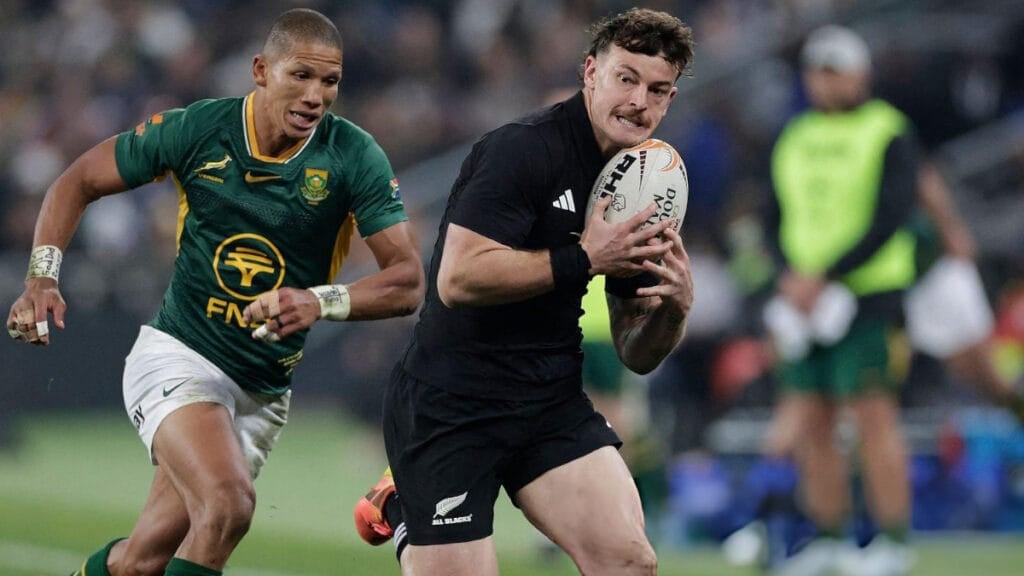
Kirwan, 63 Tests on the All Blacks wing and a World Cup winner in 1987, was adding up Ruben Love’s Saturday at FNB Stadium: a conversion missed in the first half, a penalty missed from the left of the posts on 53 minutes, a conversion missed after Will Jordan’s try three minutes later. New Zealand lost 29-24. The arithmetic does itself.
The site’s own verdict on Saturday night was that neither of those was why the All Blacks lost at FNB Stadium, and Kirwan, speaking on Sunday 6 September, did not argue with that. His point was different. The case for changing the 10 is not the kicks. It is something Love did at the 36th minute, and something Kirwan says a fly-half has to be against South Africa that Love was not.
“Seven points that you can’t leave out there”
Kirwan was asked by Ric Salizzo, who referees the show between Kirwan and Victor Matfield, whether any of the three fly-halves on display had stamped himself on the Test. He started with the tee.
“I think Ruben has been really steady. I think we left a lot of points out there. He’ll be disappointed in that. I think we left two conversions and a penalty out there. So that’s seven points that you can’t leave out there. So I think Ruben will be disappointed that he didn’t nail that. There’s some pressure on there.”
One from four, on the night. Three from four in Cape Town a week earlier, where the site gave him a 6, and his 5 in the All Blacks ratings for Soweto followed. Before both, fault-free at altitude at Ellis Park, where the All Blacks won and nobody asked about the 10.
Three Tests, three starts, and a curve that points the wrong way.
Ruben Love, steady, three times
The defence came first, and it was Kirwan’s own.
“I think Ruben’s been really steady. He’s a young man, to play in those Test matches and play well has been a real positive.”
That is not a pundit covering himself. Kirwan said steady twice more in the same segment, and the site’s position after Cape Town was that Love had kept the jersey through a Springboks pack, and would have to keep it from Richie Mo’unga. The second half of that sentence is what Sunday was about.
Steady is the right word for a fly-half whose worst moments this series have been kicks, and whose best have been the mark on 56 minutes in Cape Town that got New Zealand out of trouble, and an Ellis Park in which the game never touched him. Steady is also, against this opponent, not the job.

What a 10 has to be against this pack
Kirwan said what the job is, and he gave the mechanism.
“I do think that in the past we’ve had first-fives that in critical times will step up. I do think, though, that with the current South African side, the forward pack is the dominant part of the game, and they step up. So if you’re not really clean… I think Dave Rennie said after the game, you give away a penalty on the 10-yard mark, they’re going to kick to the corner and their maul is incredibly devastating.”
Clean is the word to hold on to. Against most sides a fly-half’s error costs field position. Against South Africa it costs seven, because the chain Rennie described on Saturday night runs penalty, corner, lineout, maul, try, and it does not need the 10 to miss a kick to start. It needs him to give the pack a reason.
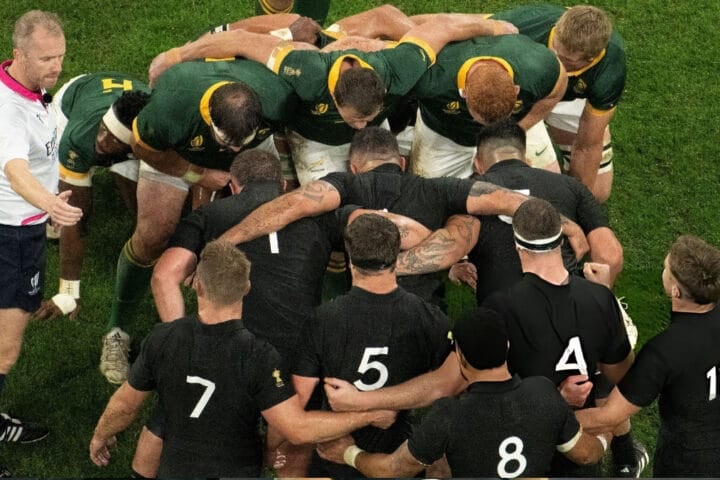
Which is what happened at 36 minutes. Love was shown a yellow card for slowing the ball down inside his own five-metre line. New Zealand packed down on their own feed five metres out with 14 men. Ox Nché went through Tyrel Lomax, and Nika Amashukeli walked under the posts for a penalty try. Seven points, awarded while the fly-half sat on the sideline.
So the arithmetic is worse than Kirwan made it. Seven left on the tee. Seven given away from the bin. The first is form. The second is the thing he was talking about.

“Do you throw him out there?”
Kirwan then said the name.
“I think there’ll be pressure on him because he’s got Richie Mo’unga and Beauden Barrett that have a whole lot of experience. So he’ll be under pressure to get selected this week, because if you’re a first-five, you have to step up in those situations.”
And, a few minutes later, the question Rennie has to answer by Thursday.
“Richie’s come back, he’s been in the squad. Do you throw him out there, or do you continue to give Ruben confidence? So I think that’s a really interesting selection for this week… I think the changes will be a little bit [forced] but also a little bit tactical. So, I wouldn’t be surprised if we see Richie out there at 10.”
Mo’unga was called to South Africa in August when Billy Proctor’s tour ended, told the NZ Herald the return was “really special”, and played his first match in the jersey since the 2023 World Cup final against the Lions at Ellis Park. Two try-saving tackles and a line break out of his own half; also a penalty kicked dead and two conversions missed from four. He has not been in a Test 23 since. Beauden Barrett has not been in one either. So the experience Kirwan is describing has, between them, zero minutes in this Rugby’s Greatest Rivalry series, and Rennie would be picking it cold for a Test with a trophy on it.
Salizzo’s observation, which started the whole exchange, was that none of the three 10s on Saturday had taken control of the game. Matfield, on the Springboks side, gave the same answer for his own team. The difference is that South Africa have two fit alternatives who have played this series and New Zealand have two who have not.
The tell for Thursday
Kirwan’s prediction is not a call. “Wouldn’t be surprised” is a man leaving the door open. What the selection will say is clearer than that.
If Mo’unga starts, Rennie has decided that the 36th minute mattered more than the kicks, and that a 10 who has spent three years in Japan is cleaner under a Springboks pack than one who has just spent three weeks under it. If Love starts, the message is that the maul is a forwards problem, the yellow card is a one-off, and steady is still worth a fourth Test.
Both are defensible. Only one of them is what Kirwan expects.

Frequently asked
How many points did Ruben Love miss against the Springboks?
Seven, on Saturday 5 September at FNB Stadium: a conversion of Ardie Savea’s second try, a penalty on 53 minutes and the conversion of Will Jordan’s try on 56. He kicked the conversion of Savea’s first try. New Zealand lost 29-24.
Why was Ruben Love yellow-carded?
For slowing the ball down inside his own five-metre line in the 36th minute. From the resulting five-metre scrum, with New Zealand a man short, the Springboks won a penalty try to level the match 12-12 at half-time.
Has Richie Mo’unga played a Test on the tour?
No. He was recalled in August after Billy Proctor’s injury, played against the Lions at Ellis Park in a midweek tour match, and has not been named in a Test 23 for any of the three Tests in South Africa.
Your turn
Kirwan says he would not be surprised to see Mo’unga at 10 in Baltimore. The team is named this week. Love or Mo’unga, on the record, before Rennie says it. Put your name to one below.






2 comments
Richie has to play in Baltimore
:D