


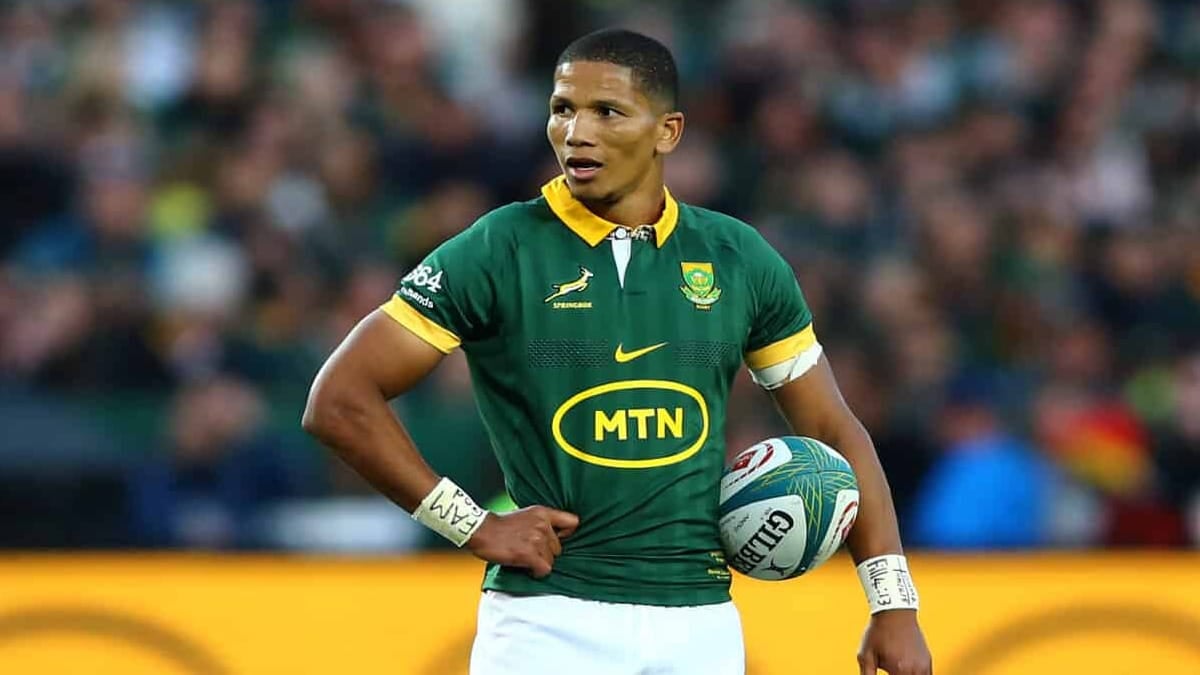
Victor Matfield was asked about the Springboks fly-half on Rugby Rivals and answered with three different teams. The one he would build around is the one who spent most of Saturday at fullback.
“So, yeah, we still don’t know who’s the guy that will take that 10 jersey.”
Victor Matfield, 127 Tests, a Springboks captain and a World Cup winner in 2007, said it on Sunday 6 September, the morning after South Africa beat New Zealand 29-24 at FNB Stadium. Then he named the guy anyway, in the next sentence, and the reason he gave is the one nobody arguing about Sacha Feinberg-Mngomezulu wants to hear.
The reason is a phrase. The thing he says Feinberg-Mngomezulu has to learn from it is further down, and it is not about kicking.
Three fly-halves, three teams
Ric Salizzo, who referees the show between Matfield and Sir John Kirwan, asked what he made of the Springboks 10 on Saturday. Matfield went wider.
“All the games there was injuries in the backs and we had to shift it around. So I think we’ve got three teams that’s quite different. I think at [Cape Town], when we were under pressure, we wanted to go back to Handré Pollard, that can really control the game, keep the forwards on the front foot, play a conservative type of game where you manage it by your forwards and your nine and 10 with a kicking game.”
Three teams is the honest description. Pollard was named at 10 for Cape Town on the Monday after Ellis Park and withdrew on the Friday with a calf strain. He was out again for Soweto. Feinberg-Mngomezulu has started all three Tests. Manie Libbok has come off the bench in the last two, and on Saturday came on after ten minutes for Cheslin Kolbe, whose jaw was broken.
So the man Matfield calls the control option has not played a minute of Rugby’s Greatest Rivalry. The two who have played all of it were both on the field for 70 minutes on Saturday, and one of them was at 15.
“Second-year syndrome”
The phrase.
“I think [Sacha’s] got the X-factor. Think he’s going through that second-year syndrome, when the first year everything just worked and it was easy, where now he had to work for it. I thought in the second half yesterday he really stepped up, although he was on 15, those kicks he had to make. And just again, I mean, his physicality on the [defence], unbelievable.”
Feinberg-Mngomezulu made his debut off the bench against Wales at Twickenham on 22 June 2024, kicked a 52-metre penalty within minutes, and spent the rest of that year looking like the easiest selection in the country. This is the second full season, and Saturday was the second-year syndrome in one evening.
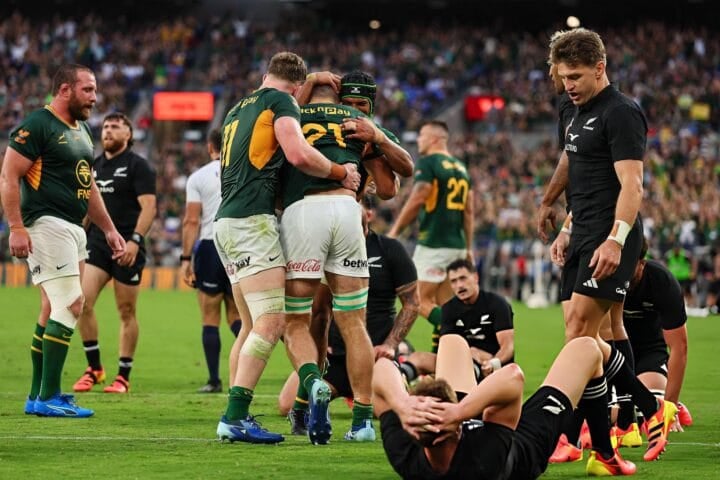
Binned at 9:20 for a deliberate knock-down ten metres from his own line, with New Zealand scoring seven while he sat. Back at 20, and moved to fullback, where he stayed. The touchline conversion of Kurt-Lee Arendse’s try missed. Then, from 15, the two conversions and the penalty that turned 19-17 into 29-17, and a tackle on Jordie Barrett in the 73rd minute that the stadium heard. A 6.5 in the Springboks ratings, marked for the ninth minute and meant to be harsh.

Dan Carter said in August that nobody becomes world class overnight. Matfield’s version is that the overnight part already happened, in 2024, and this is the morning after.
The best of the three, if you want to open it up
Then Matfield said the thing that will start the argument.
“And then in [Manie] we’ve got a 10 that, if you want to open it up, I think he’s probably the best of all three. He loves to call for the ball. He loves to get width on attack. And I mean, we scored both of our tries with him giving those long passes to the outside, and Damian firstly and then Jesse beating the guy on the outside.”
One of those is on the tape exactly as he describes it. Jesse Kriel’s try on 58 minutes came from Feinberg-Mngomezulu to Libbok to Kriel, a long flat pass and a 22-metre run past Leroy Carter for the first Springboks lead of the night. Arendse’s try on 21 is recorded on the site’s match notes as Damian de Allende’s line break and assist after a stolen lineout, which is not quite the same thing, and Matfield’s memory hands Libbok both.
The rest of Libbok’s night is in the 7 the site gave him and the 7.5 RugbyPass gave him: the clearance on 26 that missed touch and handed Ardie Savea his second try, then the break on 29, the stepping run to a metre out on 36 that produced the scrum for the penalty try, and touch-finders into the wind that turned penalties into position.
Matfield tied him to the bench nine.
“Everyone think the bomb squad is just a forward, but I thought a guy like [Morné], young nine, came up. I think he made eight or nine tackles, and that one movement he made three tackles in a row. His kicking game was also just on the spot, and I think he speeded up the game a little bit. And if you get the ball on the front foot, and [Manie Libbok] at 10, I think attack also looked much better.”
Eight or nine is Matfield’s count. RugbyPass settled for “a mountain of tackles” and a 7.5 for Morné van den Berg, on for Cobus Reinach at 43 minutes. The pairing is the point: quicker ball from the nine, a 10 who calls for it, and the width Matfield says is Libbok’s whole game.

“None of the three took control”
Salizzo’s observation, which started all of this, was that the winning side’s 10 usually stamps himself on a Test and on Saturday none of the three on display did. Kirwan agreed for New Zealand. Matfield did not disagree for South Africa.
There is a reason. Both starting fly-halves were in the sin bin before half-time, and Erasmus said afterwards that losing a 10 leaves a side disjointed. The Springboks then played 70 minutes with their starting 10 at fullback and their bench 10 at 10. Nobody took control because nobody was in the position the plan had him in.
Which makes Matfield’s verdict more interesting, not less. He watched a Test in which his first-choice 10 was moved, his best attacking 10 came on by accident and his control 10 was at home, and still picked.
Who gets the jersey in Baltimore
“So, yeah, we still don’t know who’s the guy that will take that 10 jersey. I still think it will probably be Sacha. He just needs to work through this second-year syndrome, and that always happens, because I think the expectations is so high of him, just to go out there and do magic, where I think he’ll need to learn now how to build it, just to build pressure, and when the opportunity comes, then you take it, because he’s got all the skills for that.”
Build it. Not kick it, not run it. A 10 with the X-factor plays for the moment; a 10 who has learned to build plays for the moment after next, and lets the pack and the kicking game earn it first. The fault at 9:20 on Saturday was a hand reaching for a moment. The 29-17 kick at 68 was pressure built by a maul, a turnover and a penalty, and then taken. Matfield is describing the difference between those two minutes.
Put his three answers together and there is a 23 in them. Feinberg-Mngomezulu starts, because the ceiling is his. Libbok is on the bench for the half-hour when the game needs opening. Pollard is the man you send for when there is a lead to manage in a foreign stadium with a trophy on the line. In December the site had Sacha pulling ahead in the fly-half race. Matfield keeps him ahead, for different reasons. Erasmus said on Monday that Pollard would be on the plane. Matfield has said which of the three he would give the jersey to on arrival.
Frequently asked
Who is the Springboks fly-half for the Baltimore Test?
Not yet named. Sacha Feinberg-Mngomezulu has started all three Tests of the series, Manie Libbok has come off the bench in the last two, and Handré Pollard, withdrawn from the Cape Town Test with a calf strain and left out of the Soweto 23, is due to travel. Victor Matfield’s pick is Feinberg-Mngomezulu.
Why was Sacha Feinberg-Mngomezulu yellow-carded against the All Blacks?
For a deliberate knock-down in the ninth minute, ten metres from his own line, confirmed by the TMO. New Zealand scored from the resulting penalty while he was off. He returned at 20 minutes and played the rest of the Test at fullback.
What did Victor Matfield mean by second-year syndrome?
That Feinberg-Mngomezulu’s first year in Test rugby, from his debut in June 2024, came easily, and that opponents and expectation have now caught up. Matfield’s advice was that he learns to build pressure rather than chase moments, and he still expects him to keep the jersey.
Your turn
Sacha, Manie or Handré for Baltimore. Matfield has picked, on the record, before Erasmus names his side. Put yours below and see who was right on Thursday.




Comments
No one has weighed in yet.
Be the first - what did you make of it?