



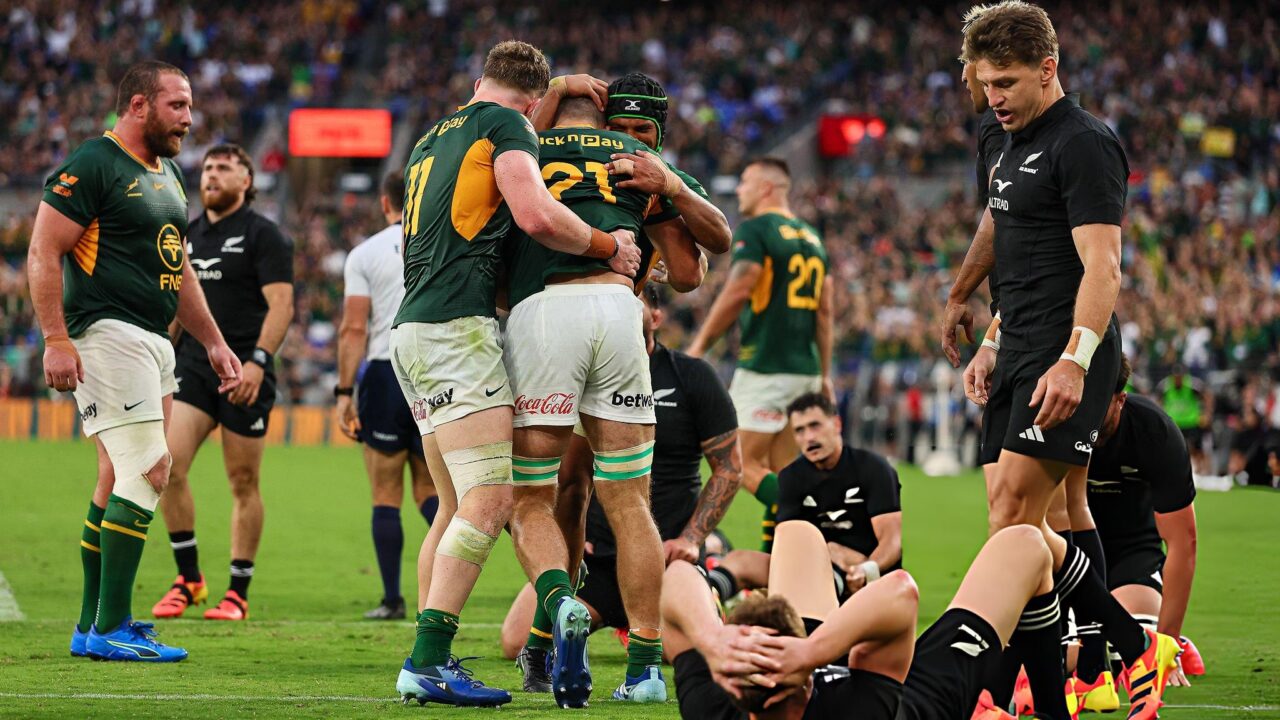
South Africa won Rugby’s Greatest Rivalry 3-1 across four Saturdays and a transatlantic flight. A Springboks vs All Blacks series review in full: nine All Blacks went home injured, one scrum penalty decided the only Test South Africa lost, and the men who played all four say what it did to them.
“After a game, always sore, but take a few painkillers on the Sunday and get the body going again on the Monday and then we rinse and repeat the week again.” Jasper Wiese, Baltimore, asked how a number 8 feels after carrying into the All Blacks every Saturday for a month.
He said it the way most people describe a commute. Four days later his side finished the job, 43-28 at M&T Bank Stadium.
Four Tests in four weekends against the same opponent. Two at altitude, one at sea level, one an ocean away. Nobody has asked these two countries to do that since 1996, and the bill came in every Sunday.
South Africa won the collision in all four. They lost the first Test by 17. And the reason they lost it is the reason they won the next three, and it fits inside one scrum penalty. That comes later.
Was that the price of beating the All Blacks, or the reason the Springboks did? Say so in the comments, then read on.
First, what it cost the men who played all of it.
What it costs to play New Zealand four Saturdays running
Wiese was asked in the same Baltimore session about the flight, and about the job itself. “The physicality contest is always the nicest part for me about it. Sometimes you’re getting dominated and sometimes you dominate. You’re not going to win every contact point.”
Eben Etzebeth, who rates four straight Tests against New Zealand above his two World Cup medals, was blunter about the cost.
“It is brutal, but it’s also with that a massive privilege, like I said, to play against the All Blacks four weeks in a row. It’s great for all of us.”
Earlier in the same week, on the schedule: “It’s been tough. It’s been some bruising battles, but I think that’s what we all want to do and we love every second of it.”
The other side said the same thing with less ceremony. On the Monday after Cape Town, Jordie Barrett was asked what two Tests against South Africa take out of a player. “Like, I’m physically sore but by the time you get to Saturday, you’re fresh mentally and physically and ready to go.” He had started both Tests at 12, opposite Damian de Allende, and would start the other two. Both men played every minute of the first three.
An ordinary week-three admission. Except that Rassie Erasmus had counted the minutes in New Zealand’s legs that morning. South Africa, he told the room, were roughly an hour lighter. Then: “So hopefully punch drunk wouldn’t come into this game.”
Steve Hansen, All Blacks head coach from 2012 to 2019, put it the way only a man outside both camps can. “They’ve gone out and knocked the crap out of each other for three Tests.”
Under all of that sits one mechanism. Tired sides do not miss tackles first. Tackling is reflex. What goes is the half-second before the tackle: the read, and the choice at the base of a ruck. Ellis Park sits around 1,700 metres up. Cape Town is at sea level. Soweto is back on the Highveld, and then came the flight west. Every one of those legs taxes the decision, not the collision. Watch the last quarter of any of the four Tests and count the late calls, not the missed tackles.
Nine All Blacks went home injured. Four of them before the first Test.
New Zealand played eight matches in five weeks. Four against franchises, Stormers 38-21, Sharks 54-0, Bulls 50-19, Lions 41-35. Then four Tests. The list below is the long one, the players whose tour ended, taken from the All Blacks’ own announcements and from SA Rugby, with the franchise games counted. The head checks and week-long knocks are further down, because Kurt-Lee Arendse failed one at Ellis Park and scored in each of the last two Tests.
| Player | Where it happened | Injury | Outcome |
|---|---|---|---|
| George Bell (NZ) | Early in the tour | Calf | Ruled out on 15 August; Bradley Slater called up |
| Billy Proctor (NZ) | Stormers, Cape Town, Friday 7 August | Fractured shoulder blade, 10 to 12 weeks | Home; Richie Mo’unga called up |
| Caleb Clarke (NZ) | Sharks, Durban, Tuesday 11 August | Ruptured shoulder tendon, surgery | Home; not replaced |
| Ollie Norris (NZ) | Off the bench in the first two games | Knee cartilage, six weeks | Home; Saula Ma’u called up |
| Cortez Ratima (NZ) | Bulls, Pretoria, Saturday 15 August | Knee | Noah Hotham in as cover; home on 6 September without a Test minute |
| Anton Segner (NZ) | After the Bulls game, where he was man of the match | Infection in the ankle joint, surgery | Home on 25 August; not replaced |
| Handré Pollard (SA) | Training, Wednesday 26 August | Calf | Withdrawn on the Friday; never played in the series |
| Cheslin Kolbe (SA) | Third Test, nine minutes | Broken jaw | Eight to ten weeks |
| Ardie Savea (NZ) | Third Test, 30 minutes | Dislocated shoulder | Home |
| Quinn Tupaea (NZ) | Third Test, off on 43 | Knee ligament (MCL) | Home |
| Luke Jacobson (NZ) | Third Test | Elbow tendon, “further investigation” | Home |
| Ben-Jason Dixon (SA) | Week of the first Test | Concussion symptoms | Never played; stayed in Johannesburg |
Sources: allblacks.com, the All Blacks statement carried by RNZ, the All Blacks’ Facebook page, the NZ Herald ledger and Rassie Erasmus’s 5 September update.
Twelve names, nine of them in black. Kolbe’s jaw is the one that changed the series. AP reported it was Luke Jacobson who ran over him, and Erasmus confirmed the jaw within the hour. Segner went home with an infection in his ankle joint that no tackle caused, ten days after 13 tackles and 12 carries against the Bulls. Ratima’s knee, by the NZ Herald’s running ledger, went in a match he was winning.
The shorter list: knocks that cost a Test, not a tour
| Player | What happened | What it cost |
|---|---|---|
| Siya Kolisi (SA) | Hamstring in Buenos Aires on 8 August | Missed Ellis Park; captain again in Cape Town |
| Cam Roigard (NZ) | Calf before the Sharks game | Missed every franchise game; started the first Test |
| Ethan de Groot and Josh Lord (NZ) | Clash of heads on 37 minutes at Ellis Park | Missed Cape Town and Soweto, after two head knocks picked the pack for Cape Town; both back in Baltimore |
| Cheslin Kolbe (SA) | Off at Ellis Park with what was first called cramp | Rated amber on the Monday, cleared on the Friday, kicked 18 points on the Saturday |
| Kurt-Lee Arendse (SA) | Failed a head check inside 14 minutes at Ellis Park | Out of the Cape Town 23; tries in Soweto and Baltimore |
| Grant Williams (SA) | A niggle after Ellis Park | Missed Cape Town and did not play again |
| Damian Willemse (SA) | Knock in the first half in Cape Town, off at the break | Missed Soweto; back at 15 in Baltimore |
| Codie Taylor and Anton Lienert-Brown (NZ) | Head wound on 48, and a second-half injury, in Baltimore | Taylor’s night as stand-in captain over with 32 minutes left; Rieko Ioane on for Lienert-Brown |
Sources: WeTalkRugby match records and team-announcement pages; Rugby365 for the de Groot and Lord minute; 1News for Roigard. Peter Lakai passed a head check in Baltimore and returned.
Rennie’s own count for the tour, given after Baltimore, was “a captured audience of what turned out to be 49 players”. Erasmus had told a Johannesburg briefing before Soweto that he expected to have used 36 by the end.

Four Saturdays, one pattern. The table South Africa will keep.
| Ellis Park | Cape Town | FNB Stadium | Baltimore | |
|---|---|---|---|---|
| Score (SA-NZ) | 16-33 | 33-26 | 29-24 | 43-28 |
| Half-time | 13-12 | 24-14 | 12-12 | 17-14 |
| Tries | 1-5 | 3-4 | 4-4 | 6-4 |
| The number | Visits to the 22: 11-9; points per visit 0.9-3.6 | Rucks won 77-111; NZ 95% of the ball in the last ten | Tackles made 150-106; scrums fed 5-11 | Metres after contact 523-369; carries 142-137 |
Sources: WeTalkRugby match records. Opta 22-visit data via RugbyPass for Ellis Park; RugbyPass ruck and possession data for Cape Town; the Stan Sport full-time board for FNB Stadium; RugbyPass and Daily Maverick for Baltimore.
South Africa carried less and hurt more at Ellis Park, 133 metres after contact to 103 in the first half off 16 fewer carries, and New Zealand lost the first hour at Ellis Park and won the Test by 17. The scoreline lied about the first hour. Eleven entries into the 22 for one try.
Cape Town was the plan corrected, not changed. Jesse Kriel scored in the first minute and South Africa led for 79 of the 80. New Zealand scored four tries to three in Cape Town and lost, because Kolbe kicked 18 points. The last ten minutes, 95 per cent of them with the ball in black hands, ended in a knock-on. Savea’s 76th-minute try was as close as it got.
Soweto was 12-12 at the break with Kolbe gone on nine and both starting fly-halves binned in one half. Then South Africa took the second half the way they had taken the first hour of Ellis Park. This time they cashed it. A penalty try from their own five-metre put-in, Kriel’s 22 metres, Malcolm Marx at the back of a 20-metre maul. It finished 29-24 at FNB Stadium after Samisoni Taukei’aho scored on the hooter.
Baltimore’s scoreline lied too, in the other direction. It was 29-21 on 65 minutes after Ethan Blackadder’s try. Then Arendse from inside his own half on 72, Cameron Hanekom off a Will Jordan turnover on 78, and 14 points in six minutes turned an eight-point game into the widest margin of the series. The ratings that night gave a 9.5 for Morné van den Berg, a first start of the series, a try, a conversion, man of the match.
Same plan every week. What changed was the finish.
The scrum penalty South Africa did not win
Back to Ellis Park, and the loop from the top.
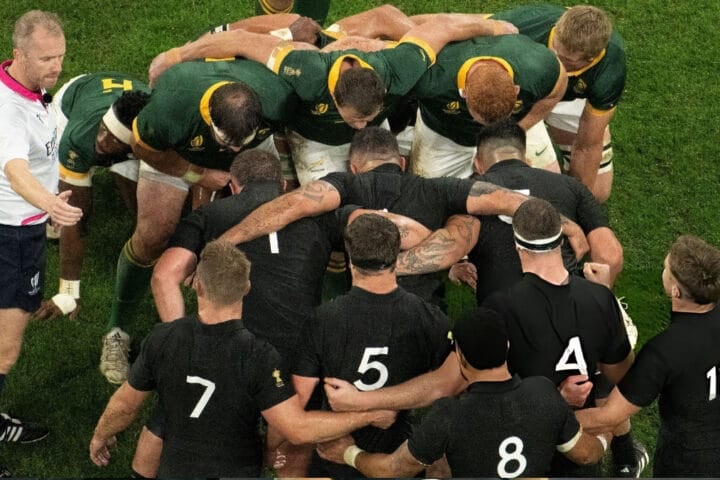
By the 55th minute the Springboks had won three second-half scrum penalties in a row, on 46, 51 and 53, and Pieter-Steph du Toit had turned down the posts twice to scrum again, hunting a yellow card for a front row that was folding. Ox Nché, the man breaking Tyrel Lomax, had gone off on 46. Kolbe’s third penalty on 47 had made it 16-12, and a minute later Fabian Holland charged down Grant Williams and New Zealand led 19-16.
Asafo Aumua came on around 54 alongside George Bower and Fletcher Newell. On 56, camped on their own line under the exact pressure that had been breaking them all evening, New Zealand won a scrum penalty.
South Africa never won another. Within two minutes Jordan had beaten five tacklers, Damian Willemse had saved a certain try, and Luke Jacobson scored from the five-metre scrum that followed. Marco van Staden was binned on 70, Cobus Reinach on 71, and Jordan scored his second against 13 men. Seventeen points in the last 22 minutes, against a side that had dominated the first 56.
Both coaches named that scrum. Erasmus called it the moment the balance changed. Rennie, asked separately, picked the same scrum.
What South Africa did about it is why the next three went the other way. They did not change the pack; Nché, Marx and Wilco Louw were back together by Soweto. They changed what the dominance bought. Kolbe took every shot at goal in Cape Town. The bench arrived in the last quarter as a unit. And in Baltimore, with the game eight points close on 65, the men who finished it were Arendse and Hanekom, running at a defence in its fourth week.
Hansen had seen the shape of it before a ball was kicked. On the Rugby Unity podcast he called South Africa at their most vulnerable in the first Test. His reason: “because they haven’t played together for a while, because of injuries, with no game time available to them other than the Argentinian Test”. New Zealand’s edge, he said, was three franchise games in eight days. “You’re practising the things you want to be able to do to a really high level at Test level.” New Zealand beat the Stormers 38-21 and the Sharks 54-0, then the Bulls, then won at Ellis Park. Hansen was right about which Test they could win. He never said they could win two.
The ledger says 121-111. Both coaches say even.
New Zealand had outscored South Africa after three Tests, 83-78 and 13 tries to eight, and were losing the series. Baltimore closed the gap in one column and widened it in the other.
| Series ledger | South Africa | New Zealand |
|---|---|---|
| Points | 121 | 111 |
| Tries | 14 | 17 |
| Conversions | 11 of 13 | 13 of 17 |
| Penalty goals | 9 of 10 | 0 of 1 |
| Points from the tee | 49 | 26 |
Source: WeTalkRugby match records for all four Tests. South Africa’s 14 tries include the Soweto penalty try, worth seven with no conversion.
New Zealand scored three more tries across four Tests and finished ten points behind, because they kicked no penalty goals in a month and South Africa kicked nine. Twenty-three points on the tee is more than twice the aggregate margin.
Neither coach reached for that. Rennie said the numbers were even. “You look at the numbers, it was a very even game tonight by the score, and we probably conceded a little bit chasing the game late.” Then the line that reads as the series: “South Africa are just a bloody good side and they’ll punish you if you give them those opportunities.”
Erasmus went further the other way. “I wouldn’t say we were the better team [today]. At 60 minutes the game was still in the balance. We appreciate that we won but the margin between us and New Zealand is very small.”
He is entitled to say it. The ledger says something else. A side that broke the scrum at Ellis Park and in Soweto, won the tackle count in Soweto by 44, the post-contact metres in Baltimore by more than 150 and the tee by 23 points is not an even side. New Zealand were the better try-scoring team in this series, and it did not matter, because South Africa were better at everything that happens before a try, and instead of one.
Winners and losers: an All Black makes the first list
Jasper Wiese, winner. Seventeen carries at Ellis Park and 17 in Baltimore, the most on the field both nights by Octafield’s count, a 9 in defeat in the first Test and painkillers on the Sunday. The series’ most honest player and its most-used carrier.
Morné van den Berg, winner. No start in three Tests, then the highest mark WeTalkRugby gave anyone in four. Reinach finished Baltimore on the wing so that van den Berg could keep the 9 shirt.
Kurt-Lee Arendse, winner. Tries in Soweto and Baltimore, more than 160 metres from seven carries in the last one, and the try that settled the series from a loose ball in his own half.
Pieter-Steph du Toit, winner. Captain at Ellis Park, 100th cap in Cape Town, a try and 22 tackles in Baltimore. Turned down the posts in the first Test and was right to.
Jordie Barrett, winner. An All Black on this list, and no argument. Fifteen tackles at Ellis Park, 14 in Soweto, 19 in Baltimore, and Damian de Allende naming him, over Ma’a Nonu and Conrad Smith, as the centre who stands out.
The All Blacks tee, loser. Nine penalty goals to none is a policy before it is a kicker. New Zealand took one shot at a penalty in four Tests and missed it.
Ruben Love, loser. Kicked four from five, three from four and one from four, then watched Richie Mo’unga start Baltimore. The Mo’unga call was made before Soweto. A fly-half with single-figure caps sent into this series is a selection, and the selection is where the blame sits.
Ardie Savea and Quinn Tupaea, losers. Savea scored three tries in two Tests and left Soweto holding his arm on 30. Tupaea’s knee went 13 minutes later. 1News reported both could miss the rest of the year.
Cheslin Kolbe, both. Eleven from eleven off the tee, a knock at Ellis Park that was called cramp and cleared by the Friday, then a broken jaw nine minutes into Soweto. The series turned on his boot in Cape Town and lost him a week later.

Frequently asked
Who won the Springboks vs All Blacks series in 2026?
South Africa won Rugby’s Greatest Rivalry 3-1. New Zealand won the first Test 33-16 at Ellis Park; South Africa won 33-26 in Cape Town, 29-24 at FNB Stadium and 43-28 in Baltimore. The aggregate was 121-111 to South Africa, with New Zealand scoring 17 tries to 14.
How many All Blacks were injured on the 2026 South Africa tour?
Nine All Blacks went home injured: George Bell, Billy Proctor, Caleb Clarke and Ollie Norris before the first Test, Anton Segner and Cortez Ratima during the series, and Ardie Savea, Quinn Tupaea and Luke Jacobson after Soweto. South Africa lost Handré Pollard, Cheslin Kolbe and Ben-Jason Dixon for the series, and Siya Kolisi, Kurt-Lee Arendse, Grant Williams and Damian Willemse each missed a Test.
Why did the Springboks lose the first Test?
They dominated the scrum and the collision for 56 minutes, entered the New Zealand 22 eleven times and scored one try. A New Zealand scrum penalty on their own line on 56 minutes, straight after Asafo Aumua came on, ended the set-piece advantage, and 17 points followed in the last 22 minutes, seven of them against 13 men.
Your turn
The same opponent every Saturday for a month, with a transatlantic flight in the fourth week. Two ways to see it. It is the best thing to happen to Test rugby since 1996, and Etzebeth’s word for it was privilege. Or it is a fixture list that sent nine All Blacks home and broke Kolbe’s jaw, and Wiese’s Sundays tell you what it did to the ones who stayed on the field. Both are true. Which one should decide whether it happens again?






Comments
No one has weighed in yet.
Be the first - what did you make of it?