
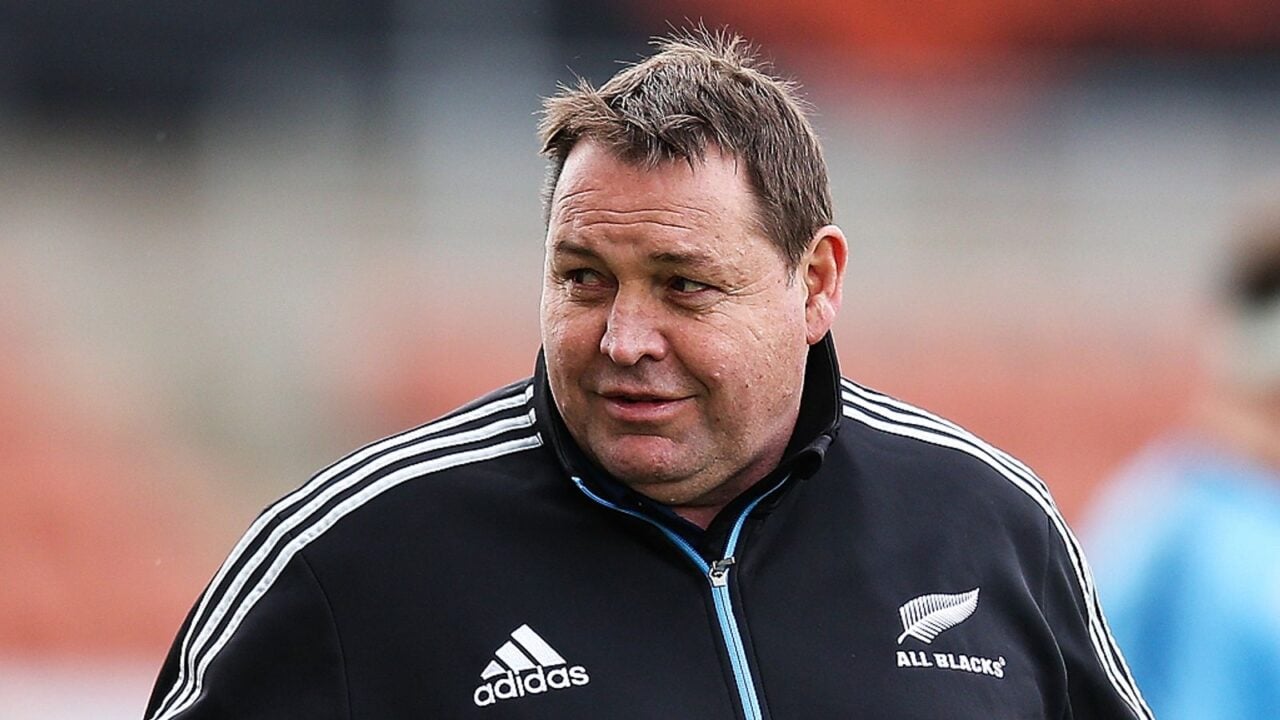
Steve Hansen has admitted he hid his self-doubt from his players. “You got to fake it till you make it sometimes,” the former All Blacks head coach told Rugby Unity this week.
Hansen won the 2015 World Cup with New Zealand. He said the doubt was still there, and he could never let the squad see it, “because you don’t have a choice cuz everybody’s looking at you.”
Can a coach fake his belief and still win? Tell us in the comments.
Hansen was speaking to host David Pembroke. He was asked how he handled personal doubt as a coach, and how Wallabies head coach Les Kiss can turn a losing run around. His answer went back to his first Test job, with Wales.
The doubt never went away, Hansen says
Pembroke asked him straight out how he dealt with it. Hansen said it started with being honest.
“You just had to be reflective and … honest with yourself and have inconvenient … conversations,” he said.
He took those talks to his senior players, his management and his assistant coaches. Once the doubt was shared, he said, it got smaller. It never vanished. “You certainly have self-doubt,” he said.
The rest of his answer was about what the players saw. “Whilst that can be bloody difficult, you … just got to do it.”

He never asked how they would win
Hansen said one question ran his week as a coach. “What could I do better this week to help this group be better?”
He also named the question he refused to ask. “I didn’t challenge myself, how are we going to win?”
The answer to his own question kept landing in the same place. “Not … showing them that I’m … doubting myself because I don’t want them to doubt themselves. So, I can’t go around doubting myself.”
He was protecting the squad from his own nerves.
“I landed the job probably when I wasn’t ready”
The Wales story came first in the conversation. Pembroke asked how Kiss might find a better performance from the Wallabies, who arrive in Cardiff on four straight defeats.
Hansen answered with his own start in Test rugby.
“I was lucky enough to coach Wales very early on in my coaching career and I landed the job probably when I wasn’t ready to do the job,” he said.
He said he had no other option but to take it. The Wales side he inherited was short of fitness and short of skill for the game he wanted to play.
So he gave the players two jobs. Get fitter. Get better with the ball, and clearer on how to use it.
The results did not follow. “We … lost I think 10 games in a row before we won one,” he said.
Why Hansen stopped looking at the scoreboard
During that run, Hansen said, he measured Wales on what they were trying to fix.
“So were we improving on the scoreboard? No,” he said. On fitness and skills, his answer flipped: “yes, we were … getting better and better all the time.”
So he kept his staff on the work. “We just had to keep concentrating on the process rather than the outcome.”
He admitted the outside world did not buy it. “And getting people to understand that was very difficult.”
He does not pretend results do not matter. He said fans and journalists are right that a coach is measured on winning. His point is that you cannot skip the steps that lead to it.
Hansen’s advice for Les Kiss
Hansen said Kiss will be doing what he did with Wales. Working out where the Wallabies are, and which parts of their game have to improve first.
The trap is panic. He warned against a mindset of “gee, we got to win, we got to win, we got to win.” He said that thinking adds pressure, tightens players up and shrinks their focus.
If the players can see they are improving, he said, belief follows. “Then eventually you’re gonna knock somebody off.”
He pointed to Wales as proof. He credited head coach Steve Tandy with building his side week by week, until they beat the All Blacks 35-28 in Cardiff last Saturday.
Then came the line Hansen built the whole answer towards. “You don’t win before you’re good enough.”
What the players see in a losing week
Hansen also described a struggling side from the dressing-room side. The players watch the coach, he said, and they notice if his behaviour changes.
His aim was for them to see the opposite. In his words, the players should think “his behavior is not changing cuz we’re losing all the time.”
He set it out as a checklist. “Okay. Well, we got to be able to do A, B, C, D, E, and F really well.”
Then the side checks each one. If A is fine and B is poor, they work on B and keep A going. He said that is the honest way to answer fans who only want to hear “win, win, win.”
Kiss gets his test in Cardiff
Australia play Wales at the Principality Stadium on Saturday 21 November in round six of the Nations Championship, kick-off 8.10pm GMT.
Hansen’s advice is easy to say and hard to live. Kiss has a home World Cup in 2027, and fans who want wins now.
Our Wales v Australia preview has the numbers behind Saturday, including the 10 missed kicks that could decide it.


Comments
No one has weighed in yet.
Be the first - what did you make of it?