


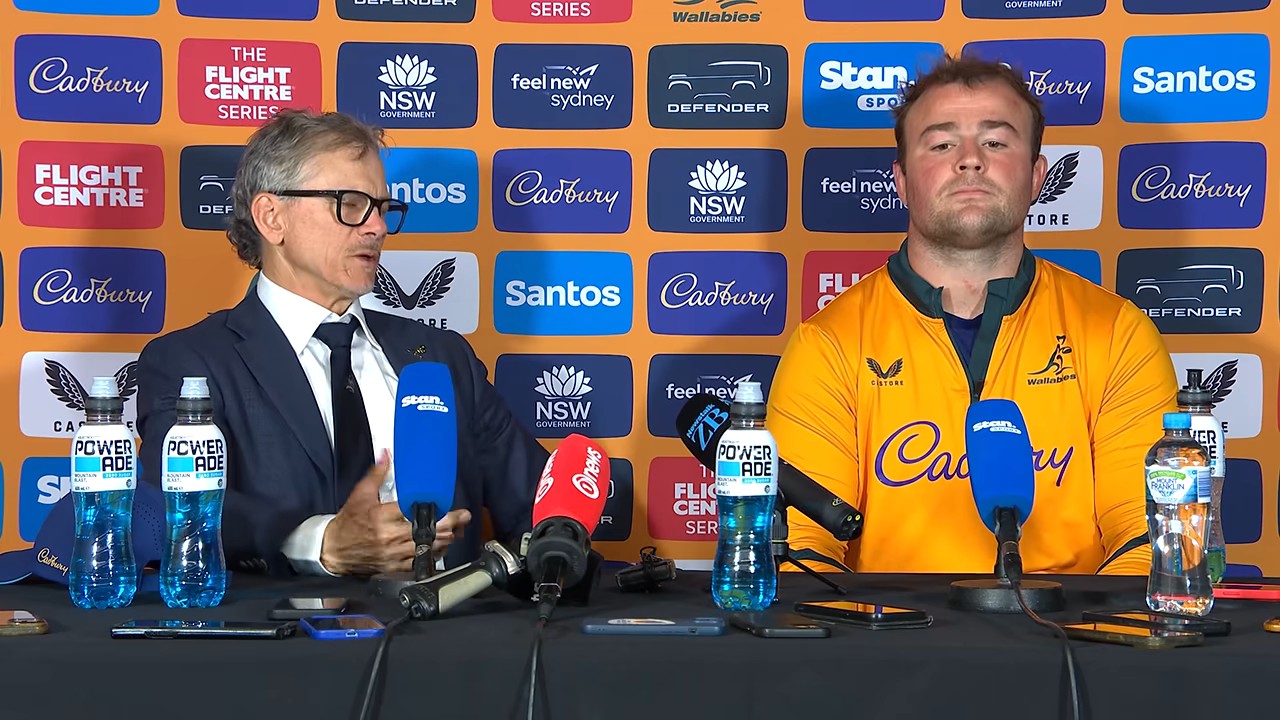
“There’s two 20-minute patches in [the] last two weeks where they really put it on us.” Les Kiss, after the 43-21 loss in Sydney.
Dave Rennie can ignore the Wallabies’ fightback in Sydney. Les Kiss cannot, and his own press conference explains why.
Australia lost 43-21 at Accor Stadium on Saturday 17 October, a week after losing the second half 33-5 at Eden Park. They trailed 36-7 at the break, then won the second half 14-7.
Richard Knowler asked in Stuff whether that rally was a warning for New Zealand. The Wallabies head coach took it as a consolation and moved straight on to the minutes that cost his side. The real answer sits in one pass on the stroke of half-time.
Should the All Blacks be worried by Sydney’s second half, or was it noise after the result was settled? Have your say in the comments.
Four runs of 21 unanswered points in three Tests
Kiss counted two 20-minute patches in two weeks. The scoring finds four runs in three Tests.
Four times in their last three Tests, the Wallabies have conceded at least 21 points without reply.
| Test | The run | Result |
|---|---|---|
| Springboks, Perth, 27 Sep | 42-17 up on 64 minutes, then 0-21 | Won 42-38 |
| All Blacks, Eden Park, 10 Oct | 14-17 at half-time, then 0-26 | Lost 19-50 |
| All Blacks, Sydney, 17 Oct | 0-22 inside 26 minutes | Lost 21-43 |
| All Blacks, Sydney, 17 Oct | 7-22 on 29 minutes, then 0-21 by the 43rd | Lost 21-43 |
Source: Rugby Australia match reports and the WeTalkRugby ratings for each Test.
Inside those four runs, Australia conceded 90 points and scored none. Outside them, they outscored South Africa and New Zealand 82-41.
Perth’s run came with four Wallabies sent to the bin in seven minutes. The first in Sydney came at 15 against 15.
Kiss described the pattern in his post-match press conference.
“A good team, that’s going to hurt you a couple of times but it happened… last week you saw it over about 20 minutes, bang, bang, bang, just couldn’t recover quick enough and we saw it today.”
Twenty minutes is the right unit. A side that loses four of those spells 90-0 can play well for the rest of the evening and still lose by 22.
What Stuff saw in the Wallabies vs All Blacks second half
Knowler’s case leans on two tries, and both were good ones.
Tom Wright finished on 54 minutes after Max Jorgensen’s footwork broke the line. On 67, Filipo Daugunu finished a length-of-field move that began with a quick goal-line drop-out, after Samisoni Taukei’aho was held up.
Knowler’s numbers fill out the argument. By his count, Australia won territory (56%) and possession (55%). They made 15 line breaks to New Zealand’s 16, and carried 171 times to 170.
Each of those is real. The two tries still came at 43-7 and 43-14. Rugby Australia’s own review allowed that “it’s tough to tell how much it was because the All Blacks were so far ahead”.
Then a real chance arrived. From the 68th minute New Zealand had no replacements left and played with 14, then 13 after Chay Fihaki’s yellow card on 76.
Australia did not score again.
Harry Wilson’s word for it: piggyback
The Wallabies captain gave the clearest account of the problem, and it starts with New Zealand’s speed.
“I probably never felt under so much pressure in the last two games when they get on top, their speed, they play with a lot of width, they put us, our sort of 30, 40, 50, 60 defenders under some extreme pressure.”
Wilson was counting defenders outward from the ruck. The 30 to 60 are the third to sixth men out. They cover the midfield and the edge, where Kiss said the All Blacks “hit some seams in the midfield, cut us up”.
The plan from Eden Park, Wilson said, “probably didn’t work”. The All Blacks kept getting over the advantage line, and Australia never got time in the tackle to slow the ball.
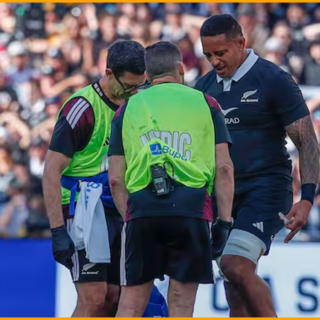
Then he named the cost.
“We’ve just got to be better as a collective. When the team scores, then we sort of piggyback them down the field and then put pressure on ourselves.”
Wilson is describing what happens after a score. One All Blacks try leads to the next because Australia hand the field position straight back. In two of the four halves, he said, “we’ve let [the] All Blacks dominate us”.
Fraser McReight, the Wallabies openside, put it more simply to Rugby Australia: “we just can’t give the team 22 points.”
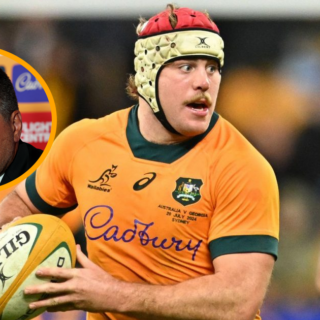
The pass on 40 minutes was worth 14 points
Both coaches went back to the same moment.
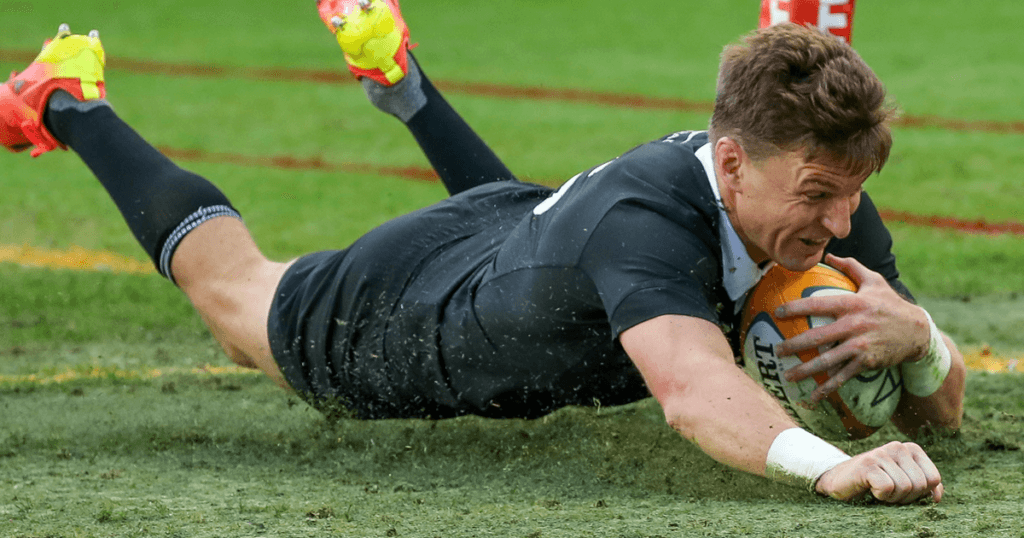
McReight was held up over the line on 39 minutes. On 40, Beauden Barrett read Jorgensen’s pass and ran 70 metres to make it 36-7.
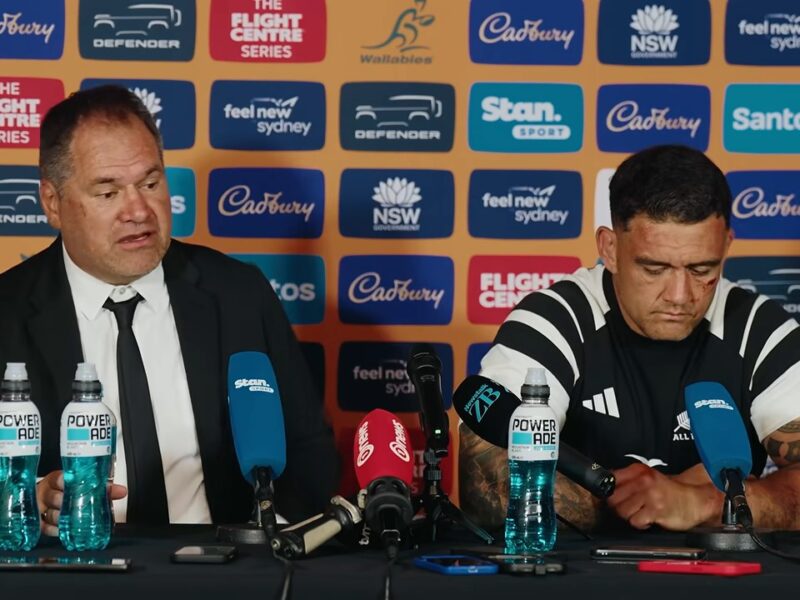
Kiss called it “the last play before half-time, that intercept”. Keep the ball there, he said, and “the scoreboard pressure becomes different”. Rennie did the maths in his own press conference.
“[If] they score there, it’s 29-14. We feel like we’ve had total dominance in the half, but… they’re in it.”
The first run had the same root. Peter Lakai turned the ball over at the end of 13 Wallabies phases on his own line. Josh Moorby scored at the other end five minutes later.
Straight after that try, Australia won the restart and set a maul five metres out. Rugby Australia’s report says the ball fell loose. Lakai broke clear soon after, and Barrett scored on 17.
Kiss then described the other half of Wilson’s piggyback.
“…they score and it’s a simple thing, a kick-off goes out and then it’s back and then they’ve got the ball again and it just puts us back on the back foot rather than managing those types of moments better.”
This is the mechanism. The restart is the conceding side’s chance to reset, and the Wallabies keep spending it. A kick-off that goes out, or a short one that misses, hands the scorers the ball back around halfway. The same 30 to 60 then defend the next wave before they have their breath back.
Kiss had already said that “a couple of restarts were a little bit off” from Declan Meredith, on a night he otherwise rated superb.
So the second half tells New Zealand very little. The tries that decided Sydney came off Wallabies attacks and restarts, while the result was still live.
Watch the minute after England score at Twickenham. If England have the ball back inside that minute, Kiss’s 20-minute patch has started.
The Wallabies’ channel has the whole press conference.

The case that New Zealand should worry
Kiss made the strongest version of Knowler’s argument himself. Outside the two patches, he said, “the rest of it is closer”, and “we’re making… a lot of breaks against one of the best teams in the world”.
Codie Taylor, the All Blacks captain, rated the Wallabies’ set piece in his own press conference.
“They’ve got a great line[out]. I think they’re the best in the world at disrupting opposition ball… they’ve also got a great maul, one of the best in the world also.”
Australia beat the Springboks 42-38 in Perth three weeks ago.
The next Wallabies vs All Blacks Test also matters more than any Bledisloe match. It is in Pool A of the World Cup, at the same stadium, on Saturday 9 October 2027. Rennie has already said the All Blacks will not play risk-free rugby at that tournament.
All of it is true, and it sharpens the point. A side that can rattle New Zealand’s lineout and beat the Springboks has the players. What it lacks is a way to stop one bad passage becoming 22 points.
“The rest of it is closer” is the whole problem in five words. Tests are settled in the patches.
Until Kiss closes them, the Wallabies’ good rugby never reaches the part of a Test that decides the result. Sydney’s second half was that rugby with the pressure off. A warning would look like the same rugby at 22-14.
Twickenham gets the next look
Kiss has three Tests in November to show the fix. England come first at Allianz Stadium, Twickenham, on Sunday 8 November. Scotland and Wales follow.
Rugby Australia expects Carter Gordon, Len Ikitau and Ben Donaldson back for the tour. None of them changes what happens in the minute after England score. That part is coaching.
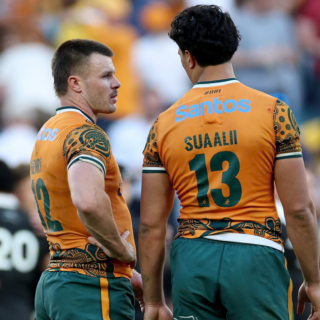
Your turn
The fix has to show up in November, and England get the first look. Do the Wallabies get through those 80 minutes without conceding 21 points in a row? Yes or no below.
Frequently asked
What was the score in Wallabies vs All Blacks in Sydney?
New Zealand won 43-21 at Accor Stadium on Saturday 17 October 2026, after leading 36-7 at half-time. It completed a 2-0 Bledisloe Cup series after the 50-19 win at Eden Park.
What did Les Kiss say after the Sydney loss?
He said the All Blacks had “two 20-minute patches in [the] last two weeks where they really put it on us”, and that “the rest of it is closer”.
When do the Wallabies play the All Blacks next?
In Pool A of Rugby World Cup 2027, at Accor Stadium in Sydney on Saturday 9 October 2027. Before that, Australia tour the north in November, starting against England at Twickenham.





Comments
No one has weighed in yet.
Be the first - what did you make of it?