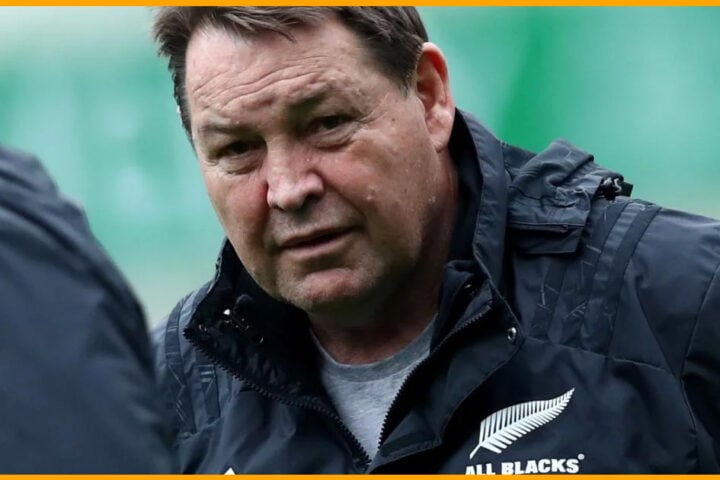
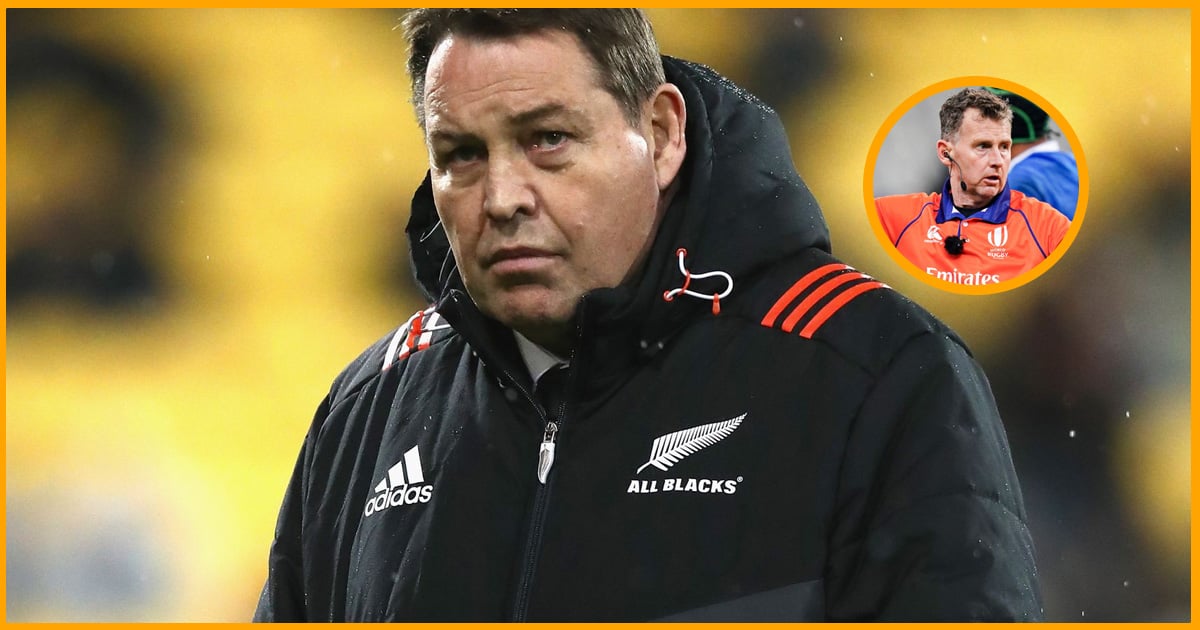
Steve Hansen told Rugby Unity that referees coaching players is not the job. Ewen McKenzie explained why the law gives them no choice.
“It’s not their job to manage the players. Their job is to adjudicate on what they’re seeing the players doing, rightly or wrongly.”
That is Steve Hansen, 107 Tests as All Blacks head coach and a World Cup winner, on the thing you hear in every match: the referee talking a defender off the ball instead of penalising him. Blow it. Let them work it out.
Then Ewen McKenzie, 51 caps as a Wallabies prop, explained why it will not stop, and his answer should worry World Rugby. So who has it right, the man who wants the whistle or the man who says referees have no choice?
Referees coaching players started as help. It became a weapon.
The question came from David, a viewer in the United States, new to the sport, writing in to David Pembroke’s show on Friday 11 September.
“Why in rugby are the referees coaching the players? In what other sport is the referee telling players what they can and can’t do? They are professional athletes yet the referee has to tell them not to touch the ball at breakdowns for example.”
Not a beginner’s complaint. It is the one Jean de Villiers made about a law World Rugby could not explain in plain English, arriving from the other end of the sport.
McKenzie went first. He did not defend the referees. He explained them.
“It’s a function of the way the laws are, that there’s so many… But it’s also tactical by the players. If you watch Ireland play, they step over the ruck. If you want to slow the ball down, you can do it in different ways.”
Too many laws, too much interpretation. Then McKenzie described the trick.
“You can obviously get your hands on the ball, or you can… step in and ask, and the referee starts telling you to get back, and all of the time the ball’s become slower.”
Read that twice. The defender steps in, the referee starts talking, and while the referee is talking nobody is playing rugby. No penalty. Nothing on the stats sheet.
“So you probably expect to see it early in the game. Whether you’re seeing that late in the game, whether it’s necessary late in the game, you’d like to think he set the game up already in terms of what standards he wants.”
Hansen would rather just see the penalty
Pembroke put it to Hansen as a habit officials fall into to keep the penalty count down. Hansen did not accept that framing either.
“I think personally they shouldn’t be doing it. I think you either let the ball go or you get penalised. The players know the rules and they’ll have done their homework on the referee.”
“And if a player asks… then yes, talk. But I don’t think, you know, ‘get your hands off, take your hands off’. I think [a] player can make his own decision. If he keeps his hands there, you penalise him.”
Pembroke pushed back. Would the penalty count not go through the roof?
“I would say that the players would immediately respond to, okay, I know we can’t touch the ball. It’s no different than if you put your hand on the hot stove. You don’t go and put it back there, do you?”
“But if you keep telling them, ‘don’t put your hand on the stove, don’t put your hand on the stove’, they’ll keep trying to put it on there until such time as they work out not to.”
Clean argument, one hole, and the hole is the stove itself. It gives the same answer every single time it is touched. A breakdown does not.
Read also: why Dave Rennie and Rassie Erasmus were kept away from the officials this series, and what both camps made of it.
Nobody can tell you the moment a ruck begins
The offside line at a breakdown does not exist until a ruck exists. A ruck needs players from both sides, on their feet, in contact over the ball. Before that moment it is still a tackle contest, and an arriving player may legally put hands on the ball and steal it, the move everybody calls a jackal. After it, he may not. Same player, same body position, same second of the match, two opposite answers.
“But then you see other times where there’s the tackle, someone cleans out, but it’s not a clean out in the old traditional sense where people stay on their feet over the ball, which is what you’re obliged to do. They actually go off their feet, and therefore you see players then reaching over the ruck to try and get at the ball. And sometimes the referee allows that and sometimes they don’t.”
“These days people go off their feet all the time and no one’s quite sure whether it’s being refereed as a ruck or it’s still some tackle contest as an opportunity to go for the ball.”
“That’s the one area of the game for me where it’s unclear, because each game it’s done differently. I see it done differently every week.”
So watch the cleanout, not the ball. If the arriving support player finishes on his feet over the tackle, a ruck has formed and the next man in commits a penalty the moment he reaches. If that same player finishes on the floor, which is what happens most of the time now, the contest may never have become a ruck at all. The jackal is legal. The referee resolves that in real time, from one angle, at full speed, every single time the ball goes to ground.
Which answers David’s question, and it does not answer it in the referee’s favour or against him. A bookshop owner in America spotted in a fortnight what the sport has argued about for twenty years. Referees talk at the breakdown because the breakdown is the one part of rugby where the players genuinely cannot know the answer until he tells them.
Nobody gets a shoeing any more
McKenzie’s next line explains what the sport swapped away.
“In the old days you had to stay on your feet. Everyone did, because if you went off your feet you got trodden on pretty quickly. So no one went off their feet.”
“You, as Steve said, you learn your lesson pretty quickly when you got a shoeing.”
McKenzie’s version of the hot stove, and note who used to be the stove. Not the referee. The fifteen men in the other jersey, with studs, and the tacit agreement of everyone watching. Anyone wanting the texture of it can read what Bakkies Botha did to Conrad Smith in every ruck he could reach.
Rugby legislated that out, correctly, for the same reasons World Rugby brought the legal tackle height down. Nobody sensible wants the rucking back. But the enforcement did not disappear when the boots did, it moved: from fifteen opponents who applied it instantly to one official who has to apply it out loud. The talking Hansen objects to is what filled the gap.
The TMO has already started stepping back
There is evidence in this series that the balance is being pulled back somewhere, at least.
“I think throughout this series we’ve seen a subtle change in the mindset, starting to take back some of the control of the game away from the TMO. I think they’re the people that have been affecting the game the most. I think they’ve been jumping in on stuff that probably we don’t need them to jump in on.”
Karl Dickson has the whistle in Baltimore on Saturday, with South Africa 2-1 up and the series already beyond New Zealand. Matthew Carley, who refereed the calls that turned the first Test at Ellis Park, runs the touchline, with Andrew Jackson on the TMO. McKenzie’s warning is narrower.
“It’s just the cleanouts, the fringe of the rucks, how wide you can clean out. We’ve seen penalties in the last game for guys being a bit too liberal in terms of the interpretation of the width of the ruck.”
They are not arguing with each other. Hansen wants the whistle instead of the lecture. McKenzie wants the law written so the whistle is obvious. Neither one blames the man holding it.
Frequently asked
Is referees coaching players normal in other sports?
Rarely to this extent, which is what prompted the question. McKenzie’s answer on Rugby Unity was that the breakdown law leaves a genuine gap: a player often cannot know whether a ruck has formed, and therefore whether he may touch the ball, until the referee says so.
When does a tackle become a ruck?
Under World Rugby Law 15, a ruck forms when at least one player from each team is in contact, on their feet, over the ball on the ground. Until then it is a tackle contest, there is no offside line, and hands on the ball are legal.
Can you use your hands once a ruck has formed?
No. The ball can then only be won with the feet, which is why the timing of a jackal matters more than the strength of it.
What did Steve Hansen say about referees?
That managing players is not their job. A referee should adjudicate on what players are doing, and one who leaves his hands on the ball should simply be penalised.
Who is refereeing the Springboks against the All Blacks in Baltimore?
Karl Dickson of England, with Matthew Carley and Christophe Ridley on the touchlines and Andrew Jackson as TMO.
Your turn
Two fixes, and only one can go first. Hansen’s is to stop the talking on Saturday, blow every set of hands, and accept a brutal opening twenty minutes while the players recalibrate. McKenzie’s is to leave the referees alone and rewrite the ruck law so the moment of formation is visible to everybody, which takes years and a lot of committees.
One is quick and painful. One is slow and permanent. Which would you start with, and would you still say it at 3-3 with twelve minutes left in Baltimore? Jason Ryan has been flagging the same breakdown work all series.