

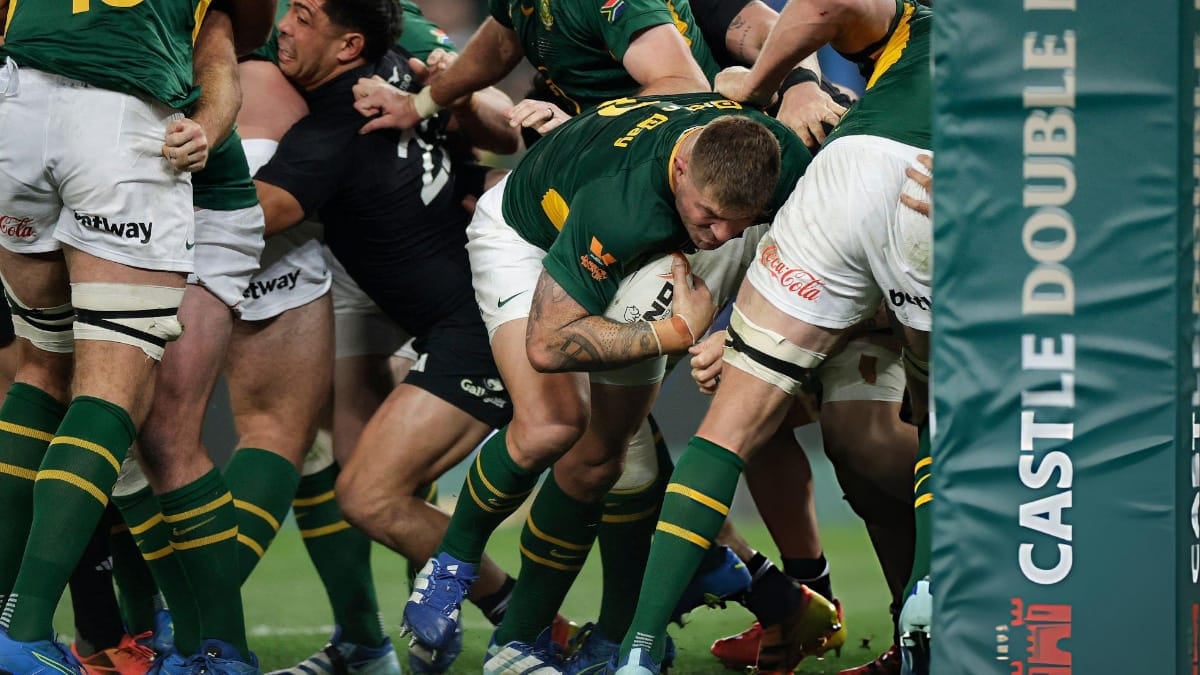
Victor Matfield was asked for his moment of the match on Rugby Rivals and picked a rolling maul. Sir John Kirwan called it the most ridiculous thing he had ever heard. One of them called the Springboks lineout for the best part of 15 years, and it shows.
“A 20-metre [maul], scoring under the posts. What? There’s just nothing more beautiful like that. It’s like a symphony orchestra going mad.”
Victor Matfield, 127 Tests in the Springboks second row, had been asked by Ric Salizzo whether he could pick a moment of the match without choosing a scrum. He could. He chose the rolling maul that took Malcolm Marx over in the 66th minute of the 29-24 win at FNB Stadium on Saturday 5 September, and he described it the way other people describe a try from their own half.
Kirwan, 63 Tests on the All Blacks wing, waited for him to finish. “That is the most ridiculous thing I’ve ever heard. Victor, how can you be so animated about a maul?”
Matfield is right, and the reason he is right is the thing Kirwan finds funny. Everyone in that maul was doing a different job. The man who scored it had done three. If you are with Kirwan, the comments are open, but read the mechanism first.
“Nothing prettier than that in a rugby game”
The full answer, from Sunday 6 September’s episode, is worth the space, because it is a lock’s description and locks do not usually get asked.
“Everyone working together, forwards working hard, working out the All Blacks on the side, coming through again, Malcolm Marx holding it, scoring under the posts. There’s just nothing prettier than that in a rugby game.”
Everyone working together is the phrase. A maul that goes five metres is a shove. A rolling maul that goes 20 metres has changed shape more than once without the ball moving, and every change was made by a different man. Matfield sees that because he spent 127 Tests inside the lineout the maul grows out of.
A rolling maul is a lineout that refuses to end
A rolling maul is a lineout that has not finished. It is also, in this Rugby’s Greatest Rivalry series, the set-piece New Zealand have not yet defended. Matfield called the Springboks lineout from 2001 to 2015, and a man who has called that many throws does not see a maul as a separate set-piece. He sees the throw still going.
Saturday’s began after Fletcher Newell had been penalised at a scrum and Manie Libbok had put the penalty in the corner. Marx threw. Pieter-Steph du Toit went up at the tail and brought it down. From there it travelled 20 metres and, on the site’s own ratings, sideways, with Marx at the back, his 8.5 in the Springboks ratings built on a clean night of throwing and that finish. RugbyPass gave him a 9 and called the drive “insatiable”.
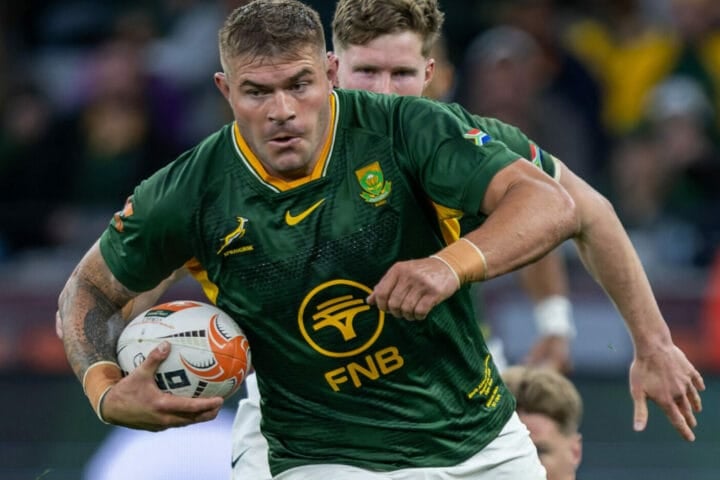
Which means the hooker threw the ball, ran to the back of the maul it produced, took the ball again and scored. Three jobs. Kirwan’s side had watched the first one and lost track of him by the third.
Every man in it had a part
The orchestra is not a figure of speech if you know where to look.

The catcher lands and turns. A jumper at the tail comes down with his back to the defence, so the ball is on the far side of his body from the men trying to get at it, and in that half-second he stops being a jumper and becomes the front of the maul. That was du Toit’s job on Saturday.
The two men who lifted him close around him before the defence can hit him. Late, and the referee is looking at a tackle. First, and he is looking at a maul, and the drive is legal.
Then the ball goes backwards through hands to Marx, and stays there.
The man at the back is the only one who can see both touchlines, so he steers. When he moves the ball to his left hip, the men on that side feel the weight change on their shoulder and the maul goes left. The engine is the men bound along the sides, hips pointing where the maul is going, and when the defensive push loads one side, the other side peels forward, the maul rotates, and what was the side becomes the new front. That is the roll. Every time it stalls, it rolls again, and each roll is a small lineout of its own.
Then there is the bench. Deon Fourie, Gerhard Steenekamp and Lood de Jager had come on at 63 minutes, a bench that had not won a last quarter all series, and three of the bodies in that maul were three minutes into their evening. The second shove, the one that turns a drive into a try, came from fresh legs.
Watch Marx’s feet, not the ball
The tell for anyone watching Baltimore next Saturday. A maul that is being pushed has its back man driving, head down, feet churning. A maul that is rolling has him walking. Watch the replay of the 66th minute with that in mind: the moment Marx’s head comes up is the moment the work has moved in front of him, to men whose names the broadcast never said.
Matfield had described him earlier in the episode, before the question about the maul came up.
“He leads that scrum, he gets over the ball, carries. So, no, he’s just unbelievable.”
Add the throw and the finish. The modern Springboks hooker is the conductor, and on Saturday the conductor also scored.
“Hugging each other and rolling and twisting”
Kirwan’s moment of the match was Will Jordan’s try, and he chose it on purpose.
“I just love seeing 15 guys getting involved. Victor loves seeing all his mates hugging each other and rolling and twisting, and they call that a maul. But I just love seeing outside backs play the game. I love seeing a 15-man game.”
It is a fair preference and it does not change the score. The Springboks rolling maul has now scored in two Tests running. Jason Ryan timed the Cape Town failure at two seconds, and two of the five moments that cost New Zealand Cape Town were their own lineout. Kirwan, for all the jokes, said the serious version himself in the same episode: “that maul, that amazing maul, we’ve just got to get way better in those tight situations.”
Rolling and twisting is what it looks like from the outside. From the inside it is eight forwards, and whoever else binds on, changing shape on a call the defence cannot hear.
What Baltimore’s lineouts are for
Every Springboks penalty inside the All Blacks’ half next Saturday is a choice between three points and a corner, and after Soweto the corner is the better bet. The All Blacks can compete for the throw or stay down. Either way, the moment du Toit lands, the rolling maul starts, and so does the orchestra.
The position, and it will not be popular in Auckland: the rolling maul is the most skilled thing eight men do together on a rugby field, and the All Blacks have gone two Tests without a skill to answer it.

Frequently asked
What is a rolling maul?
A maul forms when a ball-carrier is held by an opponent and one or more of his own team bind on. A rolling maul is one that keeps moving forward by rotating: when the defence loads one side, the attacking side on the other peels forward and the maul turns, so the ball, kept at the back, travels with it. The Springboks’ 66th-minute try in Soweto went about 20 metres this way.
Why is a rolling maul so hard to stop?
The defending side has to get in front of it before it forms. If the catcher lands, turns, and his lifters bind around him first, the drive is legal and the defence is already behind the ball. Once it rolls, the front keeps changing and the ball stays out of reach at the back.
Who scored the Springboks maul try against the All Blacks?
Malcolm Marx, in the 66th minute at FNB Stadium on Saturday 5 September, from a lineout Pieter-Steph du Toit took at the tail. Marx threw the ball in, went to the back of the maul and scored. Sacha Feinberg-Mngomezulu converted for 26-17.
Your turn
Matfield calls a 20-metre maul the prettiest thing in rugby. Kirwan calls it his mates hugging each other. One of them is describing a set-piece that has scored in consecutive Tests against New Zealand. Beauty or hugging? And if you are with Kirwan, name the skill that stops it. Settle it below.





Comments
No one has weighed in yet.
Be the first - what did you make of it?