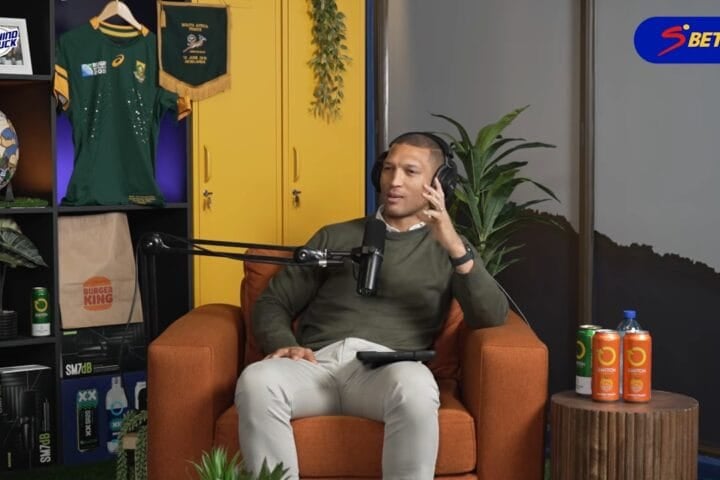

Nigel Owens has explained the Ruben Love yellow card, and the explanation is not on any replay that went round the internet.
The clip that travelled for six days is the wrong clip.
“I don’t think the footage showed this at the time,” Owens said on World Rugby’s own Whistle Watch, “a lot of people discussing this and not seeing the next ruck.”
There were two rucks.
Almost every argument since Soweto has been about the first one, where Love did nothing wrong at all. That includes the Crusaders coach who called it the harshest card in Test history. So who was watching the right ruck, and if the broadcast never cut to it, whose fault is that?
What the Ruben Love yellow card was actually for
Owens refereed 100 Tests and the 2015 World Cup final. He was taken through the incident by Jamie Roberts, the former Wales and Lions centre, who framed it the way most viewers have.
“Because I think there’s a bit of confusion here. You know, when he jumps off the line to stop the ball going, he’s actually on the line break.”
At the first ruck, an All Blacks player was offside and the referee was playing on. Not Love.
“The referee wasn’t playing an advantage against Ruben Love there. He was playing against New Zealand 13.”
Love’s shoot-up off that ruck was clean. Owens is emphatic: “He shoots off legally, and you’re thinking, ‘wow, he must have been offside’, but he’s not.”
The offence came at the next ruck. And the camera was somewhere else.
The line nobody was measuring
This is law, not opinion.
At an ordinary ruck the offside line runs through the hindmost point of the last player in it. Every replay of this one has been checked against that line.
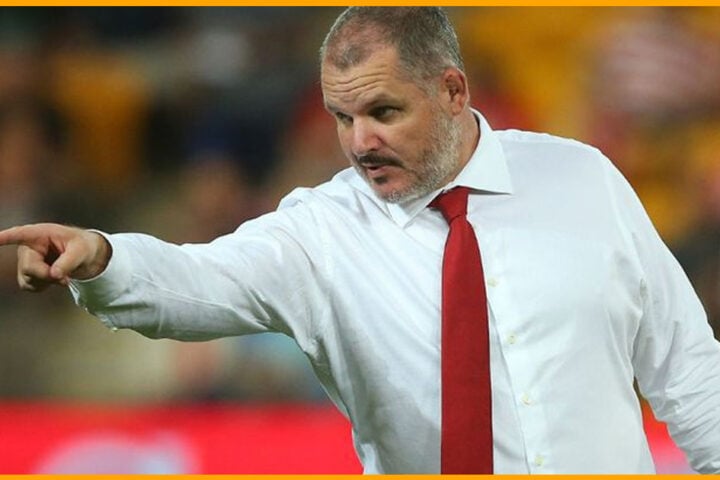
James Marshall, the Crusaders backs coach, watched it back on the What A Lad Podcast on Monday 7 September and read it as Love getting back behind the last foot before the ball was lifted. At an ordinary ruck that would settle it.
This ruck was not ordinary. It had formed on the goal line.
World Rugby’s Law 15.4 sets the offside line as running “parallel to the try line through the hindmost point of any ruck participant”. Then it adds the clause that decides this one: “If that point is on or behind the try line, the offside line for that team is the try line.”
Read it twice. When a ruck forms that close, the hindmost point stops mattering. The painted line takes over.
“The law is quite clear here, that ruck is basically on the goal line. You cannot have your foot or hand in front of that goal line. You’ve got to be on or behind the goal line. And if you look at it, Ruben Love certainly has, I think it is his left or right foot, clearly in front.”
Roberts pushed the same point on the hands, and Owens agreed. A defender with his hands on the floor there has to have them behind the line too.
Read also: how the Springboks turned the second half at FNB Stadium after the card, when the game was still level.
The referee said it first. Rennie agreed three days later
Owens is not breaking this story. He is the third man to land on it, which is rather the point.
Nika Amashukeli’s own audio was published by Planet Rugby on Tuesday 8 September. The referee names both offences in one breath.
“The first offside was by 13 there. Then you are offside here; that’s a yellow card.”
Number 13 was Quinn Tupaea. The referee’s explanation puts Love’s right foot in front of the try line at the moment Ox Nché first puts his hands on the ball.
Then Dave Rennie, whose side lost the Test, went through the footage and arrived at the same place.
“They went advantage off the first play off the line, and Ruben was clearly onside, and they said 12, which is Jordie Barrett, and both of them were clearly onside, but the next ruck, Ruben got a foot in front over the line, so that’s what the penalty is for.”
Rennie’s conclusion, to Planet Rugby on Wednesday 9 September: “It’s definitely a penalty based on the law.”
He went further, and it is a generous thing for a beaten coach to say. Asked about the card rather than the penalty, Rennie pointed at the referee’s consistency across the night.
“I think, if it had been off the first ruck, I can understand the yellow card, but I guess he’d yellow-carded one of their guys for a professional foul, so he’s consistent.”
The guy in question was Sacha Feinberg-Mngomezulu, binned on ten minutes for a deliberate knock-on. Same referee, same standard, both fly-halves.
So Marshall was not wrong about what he saw. He was measuring against the wrong line.
Both things are true at once. Love was behind the hindmost foot, and Love was still offside, because at a ruck that close the hindmost foot is not the line.
What Owens adds is the clause.
The referee said Love’s foot was in front. Rennie said Love’s foot was in front. Neither explained why that is an offence when the man is still behind the last body in the ruck. Law 15.4 is the answer, and Owens is the one who named it.
What it actually cost
Not what most people think.
South Africa turned down the three points and took the five-metre scrum on their own put-in. The pack did the rest. Ox Nché went through Tyrel Lomax, penalty try, 12-12 at the break.
Owens backs that call too, on the same principle: the question is whether a try was probable, not whether it was possible.
“That looks like a good dominant scrum disrupted by New Zealand, which meant South Africa couldn’t score, which they probably would have. So the penalty try is correct.”
Nobody was carded for it. Amashukeli gave the reason on the same audio: “It’s not going to be a yellow card because it’s a group infringement.”
Owens reaches it independently. A card follows an identifiable individual, and in a collapsing scrum there are eight of them.
South Africa won it 29-24 to go 2-1 up. The ten minutes Love spent off the field produced seven points against a side that had led for most of the half.
It is still not the reason the match went the way it did, because neither Love nor Leroy Carter is why New Zealand lost that night.
The tell to watch for on Saturday
Every goal-line ruck has a line in it most viewers cannot see, because it is the only one on the field that is actually painted.
So watch the feet. At any ruck formed within touching distance of the goal line, the defenders’ feet are what to look at, not their shoulders and not how early they break.
A fullback can be a metre behind the last body in the ruck and still be offside by the length of a boot.
Love is not in the 23 in Baltimore. Damian McKenzie starts at 15 and Richie Mo’unga at 10, and Rennie has said plainly that Richie Mo’unga was always coming back for Baltimore regardless of Soweto. Whatever the card was, it is not why he is out.
Frequently asked
Was the Ruben Love yellow card correct?
Three officials and coaches say yes, independently. Referee Nika Amashukeli’s audio, published 8 September, puts Love’s right foot in front of the try line at a ruck on the goal line. Dave Rennie reached the same conclusion on 9 September. Nigel Owens agreed on Whistle Watch on Friday 11 September and named the law clause behind it.
Why do people think it was not a penalty?
Because the widely shared clip shows Love breaking off the defensive line at an earlier ruck, which was legal. James Marshall, the Crusaders backs coach, said on the What A Lad Podcast on Monday 7 September that the replay shows Love behind the line when the ball was picked up. The offence happened at the following ruck, which the broadcast did not show at the time.
What is the offside line at a ruck on the goal line?
Law 15.4 puts the offside line through the hindmost point of any ruck participant, but adds that if that point is on or behind the try line, the offside line for that team becomes the try line. A defender must be on or behind the goal line, with his feet and his hands.
Why was there no yellow card for the penalty try?
Amashukeli said on the referee audio that it was “a group infringement”. Owens gives the same reason: a card follows an identifiable individual, and a collapsing scrum involves too many players to name one. The exception he gives is a flanker who detaches from the scrum to stop the number 8.
Your turn
Two ways to see this.
Either the card was right all along and a week of outrage was aimed at a phase of play where nothing happened, which makes it a broadcasting failure. Or a decision needing referee audio, a coach’s review and a law clause to explain it was never clear and obvious in the first place.
One of those is a directing problem. The other is a refereeing problem. Which was it?