
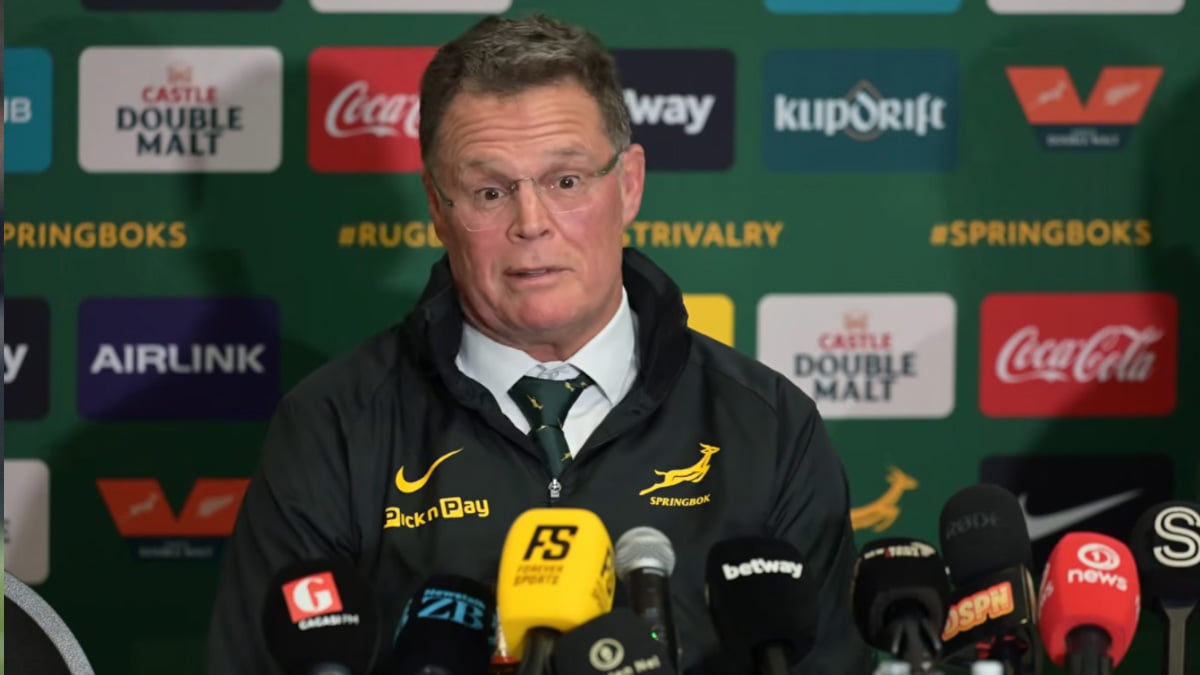
Two post-match press conferences at FNB Stadium on Saturday 5 September, and the Rassie Erasmus scrum row ended in both. Dave Rennie needed a dozen words, Erasmus the free kick his own pack had conceded.
“Just after last week, Dave really said he had no problem with the scrum tonight.” A journalist, to Erasmus, an hour after the 29-24 win. How satisfying had it been?
Erasmus started with the free kick and the scrum penalty his pack had given away. Fifteen minutes later he named the set-piece his side would pick, given the choice. It was not the scrum. That answer is further down.
Coaches who have just been proved right do not usually open like that. Erasmus had spent a fortnight being told his scrum was illegal, had sworn about it on television, and had then watched a five-metre scrum at 36 minutes produce a penalty try. The vindication was being handed to him. He handed it back, twice. Whether that was honesty or management is the argument at the bottom of this page, and the comments are open.
A fortnight of walking around, one expletive, and then a penalty try
Rennie took the Springboks scrum to World Rugby on Thursday 27 August, said after Cape Town that it was walking around the All Blacks tightheads, and on Thursday 3 September asked for the referee’s footage. Erasmus’s Cape Town reply, as 1News reported it, had an expletive in the middle of “we’re not walking around, we’re scrumming through”. Daan Human, who coaches the Springboks scrum, answered with six years and a farm. By Thursday George Bower, the All Blacks loosehead, was saying the first scrum in Soweto would do the talking.
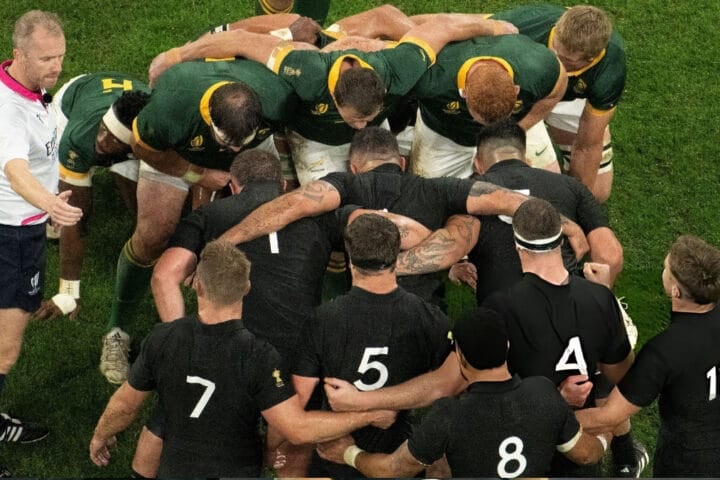
Then Saturday. Wilco Louw’s shove won a penalty at a Springboks scrum after 14 minutes. At 36, with Ruben Love in the bin and New Zealand packing down on their own feed five metres from their line, Ox Nché went through Tyrel Lomax and Nika Amashukeli awarded a penalty try. Twelve-all at the break, in a Test South Africa won 29-24 to go 2-1 up in Rugby’s Greatest Rivalry.
Rennie, at his own press conference, was asked for his assessment of the scrums.
“They get rewarded for dominance at times, so no issues with that.”
Luke Jacobson, who took the captaincy when Ardie Savea’s shoulder gave out at the half hour, was asked the same: “There was obviously that one that they scored off, which dented us, but it was fairly competitive.”
So New Zealand had conceded the argument before Erasmus sat down. He could have taken the win and gone to the plane.
“I’ve moaned in the media in the past. I’ve got banned.”
“I think we were caught for a free kick, we were caught for collapsing one. So… I’m the last one, probably, to talk about that, because I have moaned in the media in the past. I just think the frustration was just not because [of] what was raised, it was: was it at the right platform, you know, should it be out there. And I’ve been guilty in the past, so I’ve learned my lesson, I’ve got banned and things like that, and then you sort of expect everybody else also to do it that way.”
The free kick went against Louw, for leaning in, on the stroke of half-time. The scrum penalty against South Africa came early in the second half. Neither cost a point. Erasmus listed them first anyway.
“I’ve got banned” covers two World Rugby suspensions: two months from all rugby activity in November 2021 for the hour-long video about the referee in the second Lions Test, and two matches in November 2022 for social-media posts about the officials after the Ireland and France defeats. A coach with that record, arguing that a scrum grievance belongs in the review system rather than a press conference, is arguing with his younger self.
Then he said this about the man who had spent two weeks calling his scrum a con.
“I don’t know how many people know Dave. He’s a gentleman. He definitely coach[es] a very brutal way, and it’s sometimes difficult to get around the smart things that he coaches. And I don’t think we were dominant in the scrums. I think there were times when it was pretty equal, and things could have gone against us.”
“Brutal” is a compliment here, and a precise one. Rennie’s own description of the plan was high tempo, so that “a lot of their big men” were struggling in the first half. The Springboks pack that produced the penalty try was, on both coaches’ accounts, being run off its feet before it. The brutal part and the smart part are the same plan.
Five scrums against eleven: the Rassie Erasmus scrum ledger checks out
“Pretty equal” is checkable, so check it.
Stan Sport’s full-time graphic had South Africa winning five scrums from five on their own feed and New Zealand eleven from eleven. Not one scrum was lost against the head. On the ledger, Erasmus is right.
The scoreboard is a different document. The two scrum penalties that mattered were both South Africa’s: Louw’s shove on their own put-in at 14 minutes, and the five-metre scrum on New Zealand’s feed at 36 that Amashukeli decided without waiting for the ball. Seven points from a scrum, in a Test settled by five.
And eleven New Zealand feeds against five is not a scrum statistic. It is a handling statistic. Stan Sport counted 13 South African handling errors to New Zealand’s ten, and every Springboks knock-on handed the All Blacks a put-in. The problem for New Zealand was what the put-in was worth. Their own feed, five metres out, ended under their posts. Against any other pack in the world a knock-on costs you the ball. Against this one it can cost you seven.

“We would never pick a scrum”
Then the sentence that ends the fortnight.
“I’m just glad the narrative of… games at the scrums, it’s really not a South African thing. I mean… I can tell you we like high balls and we like the kicking game and we like mauling, but we would never pick a scrum. So I hope that we park that now. We park that now, because they scrummed flipping well tonight. There was a few scrums where we were under the pump, where we were glad they got the ball out and didn’t keep on scrumming. So, you know, the changes he made really made a hell of a difference. And if we can park that and just concentrate on, he calls it footy, have some good footy next week.”
Read the list again. High balls, the kicking game, the maul. The coach of the 7-1 bench and the pack that had just scored a penalty try listed the things his team chooses, and the scrum was not on it. The scrum is what South Africa do to you when you drop the ball. It is a tax on your errors, collected by Nché, whose second shove is the reason the Springboks scrum remains South Africa’s key Test advantage. Nobody picks a tax.
“Glad they got the ball out and didn’t keep on scrumming” is the most useful technical line either coach produced on Saturday, and it is worth a replay. At the All Blacks scrums after half-time, watch how quickly the scrum-half plays the ball once it reaches the back. A pack that clears at the first sign of stability has chosen a platform over a contest. The Springboks were braced for a contest and, on their coach’s account, got a platform instead.
Rennie had moved three forwards for the third Test, and this site read the changes as being for the lineout rather than the scrum, with Asafo Aumua in for Codie Taylor at hooker. Both readings survive. Aumua’s throwing gave New Zealand a lineout, and a front row that got the ball out gave them a scrum they could play from.
The set-piece he did claim
Fifteen minutes into the press conference, asked what explained the win, Erasmus ranked his own set-pieces.
“I don’t think we dominated the scrums. I think we mauled exceptionally well today… We love scrums, we really love scrums, but we love mauling as well.”
The maul is the one South Africa picked. In the 63rd minute Will Jordan’s long kick bounced dead through the in-goal and South Africa took the scrum where it was kicked. Fletcher Newell was penalised at that scrum, Manie Libbok put the penalty in the corner, Pieter-Steph du Toit took the lineout at the back, and Malcolm Marx scored off a maul that rolled 20 metres. Rennie had the whole sequence in one sentence: “You come back for a scrum, which is a penalty, to a maul where they drive however many metres to score.” Asked how you stop that maul, his first answer was “probably a good question for someone else”.
Scrum, penalty, lineout, maul, try. The scrum was the second link. The maul was the point.
The generous reading
There is a more cynical way to hear a coach giving away a scrum he has just won with. South Africa are 2-1 up, cannot lose the series, and share a plane to Baltimore with the team they beat. A quiet week costs Erasmus nothing, and parking the scrum spares whoever holds the whistle in Baltimore from reading anything into it.
The answer is in the order he said things. He named the free kick and the penalty against his own pack before anyone in the room had mentioned the penalty try. He credited New Zealand’s front row for a change nobody had asked him about. A coach managing a story leads with the penalty try. Erasmus led with the free kick against his own tighthead, and the ledger backs him: the scrums finished level.
His will be a little bit more bitter
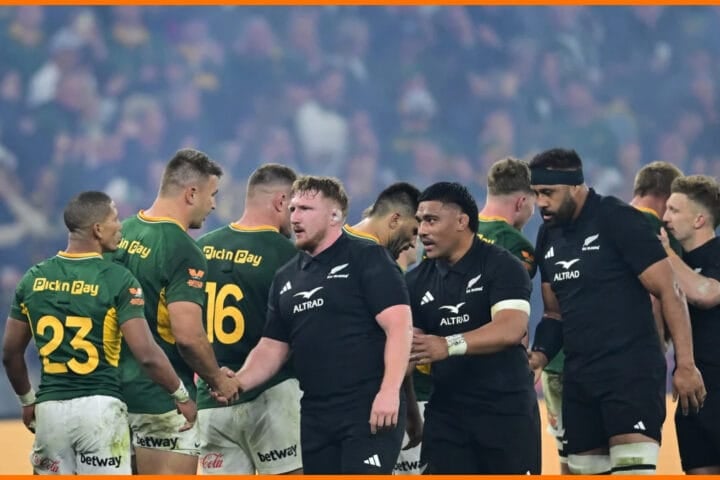
The scrum row ended twice on Saturday night, and the coach who had been proved right gave up the most ground. Rennie needed one sentence. Erasmus needed two old bans, a free kick, “gentleman”, “not dominant”, “we would never pick a scrum” and “park that now”, and then a maul he was happy to claim.
He had opened the press conference with an apology for the Cape Town language: “I got into trouble last time and I really apologised for that last weekend. It was not well-mannered. I apologise.” He closed the English section by swearing again, on purpose, with a warning first: “I’m gonna swear again. It’s flippin’ important.”
In between, the beer. Both squads boarded the same charter for Baltimore after the match. “Hopefully me and Dave will have a beer,” Erasmus said. “His will be a little bit more bitter and mine will be a little bit more sweeter.”

Frequently asked
What did Rassie Erasmus say about the scrum after the third Test?
At FNB Stadium on Saturday 5 September he said his pack had been “caught for a free kick”, that he had “moaned in the media in the past” and been banned, that Dave Rennie is “a gentleman”, that the Springboks were “not dominant”, and that “we would never pick a scrum”.
What did Dave Rennie say about the Springboks scrum in Soweto?
Asked for his assessment of the scrums after the 29-24 defeat, Rennie said: “They get rewarded for dominance at times, so no issues with that.” Luke Jacobson called the scrums “fairly competitive” apart from the five-metre scrum that produced the penalty try.
How did the scrums go at FNB Stadium?
Both sides won every scrum on their own feed, five for South Africa and eleven for New Zealand on Stan Sport’s full-time graphic. Wilco Louw won a scrum penalty at 14 minutes, the five-metre scrum at 36 produced a penalty try, and Fletcher Newell was penalised at the 63rd-minute scrum that led to Malcolm Marx’s maul try.
Your turn
Two ways to hear “pretty equal”. Either it is a coach describing a scrum ledger that finished level and refusing to dress up two calls that went his way, or it is a coach 2-1 up buying a quiet week before Baltimore with a compliment that cost him nothing. One of those is honesty and the other is management. Which one did you hear? Settle it below.



Comments
No one has weighed in yet.
Be the first - what did you make of it?