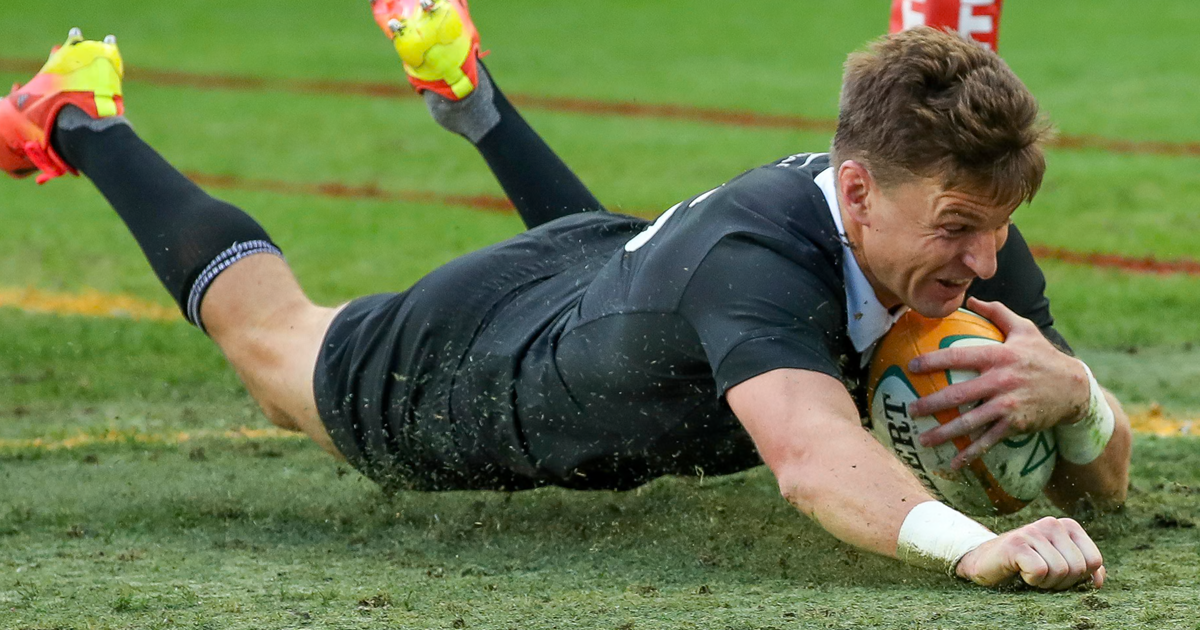
For 43 minutes, every time the Wallabies left the All Blacks’ 22 empty-handed, the All Blacks went up the other end and scored. Beauden Barrett did it twice, and the second came from 70 metres.
The All Blacks beat the Wallabies 43-21 at Accor Stadium in Sydney on Saturday 17 October to sweep the series 2-0. It was 36-7 at half-time.
Then they stopped. No points after the 43rd minute, and 13 men on the field at the finish.
Barrett with two tries, or Peter Lakai with the seventh-minute turnover and a try: who was your All Blacks player of the match? And should Damian McKenzie’s 4 from 7 off the tee cost him a mark? Have your say in the comments.
All Blacks player ratings vs Wallabies: six tries in 40 minutes
How to read the marks: 10 legendary · 9 outstanding · 8 very good · 7 good · 6 solid · 5 average · 4 poor · 1-3 disaster. Half-marks allowed.
All Blacks backs: Barrett and Moorby scored four of the seven tries
Both tries came straight after a wasted Wallabies attack. The first, on 17 minutes, finished a set-piece move that Lakai broke open. The second ended the half as a contest: he read Max Jorgensen’s pass on 40 minutes and ran it in from 70 metres for 36-7.
A third was on in the second half until Declan Meredith’s try-saving tackle. Roigard had started that counter from inside his own 22.
Replaced by Chay Fihaki at half-time. Six tries went in during his 40 minutes without his name on any of them, and he did his job without standing out.
Named on the bench, then handed the 12 shirt when Jordie Barrett was ruled out on match day with a tight calf. His line break three minutes into the second half made Moorby’s second try.
He went off injured on 68 minutes with the bench already used, and the All Blacks played on with 14.
7out of 10
11
11. Josh MoorbyWing · 80 min
Two tries on his first start of the series. He backed up Codie Taylor’s second line break for the opener on 12 minutes, then finished Tavatavanawai’s break on 43.
Those were the All Blacks’ first points and their last.
Ran the game from the first minute to the last, and the forwards attacked off his calls all night. The blemish is the tee: 4 from 7, with the conversions on 12, 17 and 26 minutes missed.
Six points went begging, which costs nothing in a 43-21 win and would cost plenty against the Springboks.
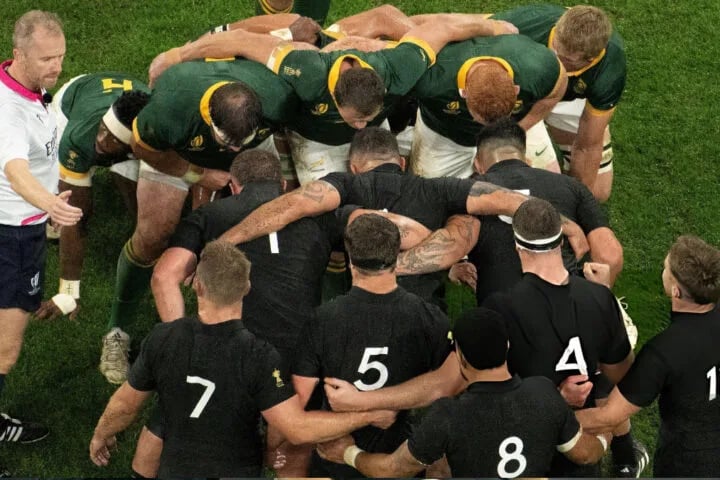
The first scrum of the match did not come until the 32nd minute, and Sititi scored off it from five metres. Jeremy Williams had gone to the bin a minute earlier. Shannon Frizell replaced him on 55.
The Wallabies had gone through 13 phases on the All Blacks’ line when Lakai won the turnover inside his own 22 on seven minutes. Turnovers like that deserve a column of their own on the scoresheet.
Ten minutes later his line break made Barrett’s first try, and on 21 he scored his own after a TMO check. Three defenders beaten inside 19 minutes. Rugby Australia named him player of the match.
On inside two minutes for Quinn Tupaea, so this was a starter’s shift in everything but the number. He took the ball on the end of the line on 26 minutes and was too strong for Tom Wright for the fourth try.
A Test debut from half-time, in place of Jordan. He made a line break, then could not gather his own grubber.
With four minutes left he was sent to the bin for head-on-head contact with Joseph-Aukuso Suaalii. Tavatavanawai was already off with the bench empty, so the All Blacks finished with 13.
Runner-up: Peter Lakai (8.5/10). Rugby Australia gave him the official award, and the seventh-minute turnover is a fair reason. Roigard, also on 8.5, loses the tie-break: his try-saver came at 43-14, Lakai’s turnover at 0-0.
Barrett or Lakai? Pick one in the comments.
Why did the All Blacks stop scoring after 43 minutes?
The changes came early. Fihaki replaced Jordan at half-time, and the whole front row was changed on 49 minutes. From that point the Wallabies won the game 14-0.
Frizell lasted six minutes. When Tavatavanawai went off on 68 there was nobody left to send on.
The moment that flipped the first-half pattern came on 66 minutes. Taukei’aho was held up over the line, and the Wallabies ran the drop-out back the length of the field for Daugunu’s try. For once, a wasted visit to the 22 cost the All Blacks.
Taylor told Nine his side “were awesome in that first 40”. Then: “That second 40 was a bit different.” It finished 14-7 to Australia, with a debutant in the bin.
The McKenzie-Roigard axis ran the game, and the Springboks should test it
Nick Phipps, the former Wallabies scrum-half, was on ABC’s commentary. Early in the first half he said “the speed of service at the breakdown from the All Blacks was too quick.”
The broadcast numbers at 34 minutes show what that speed bought. Six entries to the Wallabies’ 22, at 4.8 points a visit.
Nobody in gold slowed that ball down. The Springboks are the side to try it against next.
43-21, and the Wallabies still broke the line more often
Full time: New Zealand 43-21 Australia (half-time 36-7), Accor Stadium, Sydney, Saturday 17 October 2026. Attendance 73,399.
New Zealand 43. Tries: Josh Moorby 2, Beauden Barrett 2, Peter Lakai, Rieko Ioane, Wallace Sititi. Conversions: Damian McKenzie 4 from 7.
Australia 21. Tries: Jeremy Williams, Tom Wright, Filipo Daugunu. Conversions: Ryan Lonergan 2, Declan Meredith 1.
Yellow cards: Jeremy Williams (31 minutes), Chay Fihaki (76). Referee: Luke Pearce (England). TMO: Marius van der Westhuizen (South Africa).
At 43-7 the Wallabies led the line breaks 6-4 and had spent longer in the opposition 22, 3:40 to 2:51. New Zealand still took 5.4 points a visit to their 1.4. It is a 13th straight All Blacks win over the Wallabies.
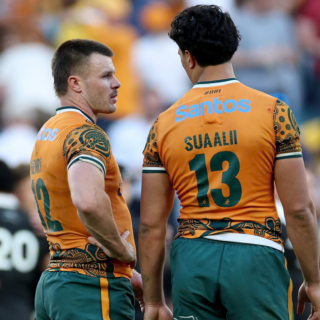
The Wallabies team for Eden Park has one change, Isaac Henry at 13, and keeps Joseph-Aukuso Suaalii on the wing. The reason is the All Blacks back three.
To provide the best experiences, we use technologies like cookies to store and/or access device information. Consenting to these technologies will allow us to process data such as browsing behavior or unique IDs on this site. Not consenting or withdrawing consent, may adversely affect certain features and functions.
Functional
Always active
The technical storage or access is strictly necessary for the legitimate purpose of enabling the use of a specific service explicitly requested by the subscriber or user, or for the sole purpose of carrying out the transmission of a communication over an electronic communications network.
Preferences
The technical storage or access is necessary for the legitimate purpose of storing preferences that are not requested by the subscriber or user.
Statistics
The technical storage or access that is used exclusively for statistical purposes.The technical storage or access that is used exclusively for anonymous statistical purposes. Without a subpoena, voluntary compliance on the part of your Internet Service Provider, or additional records from a third party, information stored or retrieved for this purpose alone cannot usually be used to identify you.
Marketing
The technical storage or access is required to create user profiles to send advertising, or to track the user on a website or across several websites for similar marketing purposes.



























Comments
No one has weighed in yet.
Be the first - what did you make of it?