




Ewen McKenzie read four lines of numbers out on Rugby Unity on Monday. The fourth one is why South Africa are a draw from the series.
Eighty-three points to 78. Thirteen tries to eight. Nine conversions to six.
And then the fourth line: eight penalty goals to none.
Those are the Springboks vs All Blacks stats after three Tests of Rugby’s Greatest Rivalry, and the side winning every one of the first three lines is New Zealand. The side that won 29-24 at FNB Stadium on Saturday to lead 2-1, and needs only a draw in Baltimore to take the series, is South Africa.
McKenzie, 51 Tests at tighthead prop for the Wallabies and their head coach in 2013 and 2014, put the four lines on the table on Monday without a flourish. “Eight tries to 13. Six conversions to nine. But eight penalties to zero. So New Zealand haven’t opted to take shots at goal, or haven’t kicked them, whatever. But there was a point. That’s the point.”
There is a fifth line under his four. He did not read it out, and it makes the zero look kinder than it is. It is further down.
If you think the answer is Ruben Love’s boot, the comments are at the bottom. Read the fifth line first.
Springboks vs All Blacks stats: the table South Africa will not mind reading
| Ellis Park | Cape Town | FNB Stadium | Series | |
|---|---|---|---|---|
| Score (SA-NZ) | 16-33 | 33-26 | 29-24 | 78-83 |
| Tries | 1-5 | 3-4 | 4-4 | 8-13 |
| Conversions | 1-4 | 3-3 | 2-2 | 6-9 |
| Penalty goals | 3-0 | 4-0 | 1-0 | 8-0 |
Source: WeTalkRugby match records for Saturday 22 August, Saturday 29 August and Saturday 5 September. The penalty try in Soweto counts as a try and carries no conversion.
A side that scores 13 tries in three Tests against the world champions has done the hard part. New Zealand have crossed from counter-attack, from a grubber off the opposite wing, from a charge-down, from a pick-and-go after the hooter. South Africa’s eight include a penalty try from a five-metre scrum and Malcolm Marx at the back of a 20-metre maul.
Hansen’s view of South Africa is not the one New Zealand usually hears. “They’re very skilled, a lot more skilled than people give them credit for, I think.” And McKenzie, on why eight tries to 13 will not bother anyone in green: “They get excited by mauls and scrums. If it was an Australian crowd, they’re not interested in that. They want to see the backs attacking.”
McKenzie’s reading of the tries was the most honest line of the week.
“Some of the attacking football they played at times, you won’t see better. Go back through the tapes and have a look, people that want to coach… The skill execution was brilliant, but not good enough to win the game, unfortunately. And you’d like to think in rugby that brilliant attack is going to somehow reward you on the scoreboard, but that’s not how the game’s designed. It’s got two elements to it, and in the end the Springboks were good enough.”
Two elements. The tries are one. The other is the fourth line.
Eight to none is a decision before it is a miss
New Zealand have taken one shot at goal from a penalty in three Tests. Ruben Love took it from the left of the posts on 53 minutes in Soweto, and missed.
No other shot at goal from a penalty appears in the three match records. They kicked no penalties in Cape Town, and they kicked none at Ellis Park either, where the choice was vindicated: they lost the first hour at Ellis Park and won by 17 with five tries. A side that scores five tries does not need three points at a time.
It has needed them since. Cape Town was lost by seven. Soweto was lost by five.
The policy only works if the tries are worth seven. McKenzie said on Friday’s preview show, before the third Test was played, why they have not been: “New Zealand have been scoring tries out wide and not converting them. They’re difficult kicks, obviously. So they’re getting the five points, but they’re not getting the seven.”
Thirteen tries, nine conversions. Four of the 13 were worth five instead of seven, and the misses in Cape Town and Soweto were all from the touchline or the corner. A rush defence takes the middle of the field away and gives up the last five metres of width late, so against the Springboks the tries come in the corner and the kicks come from the touchline.
Par at scrum time, or no tee at all
Steve Hansen, All Blacks head coach from 2012 to 2019 and a World Cup winner in 2015, did not talk about kickers on Monday. He talked about where a kickable penalty comes from.
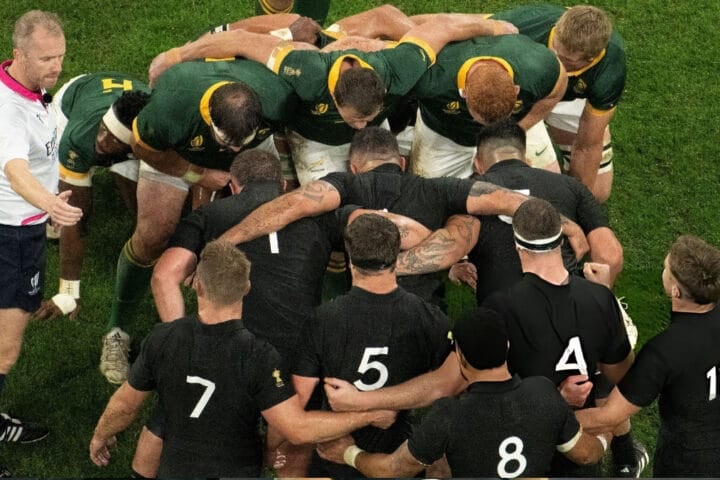
“You’re not going to beat the Boks until you can get par at scrum time and you can get decent ball in the lineout. A lot of the times we were having to go to the front and it was messy or ugly, and you’re letting them get a free shot at you from the back with their defensive system the way it is. So you’ve really got to try and win ball at the back.”
A scrum penalty arrives with the referee’s arm already up and a choice attached: three points, or a lineout five metres out with a maul behind it. Either way it is points, and the choice belongs to the side with the stronger eight. A breakdown penalty won on the edge arrives on the 15-metre line and becomes a lineout at the front.

Soweto showed the first kind in full. New Zealand fed 11 scrums to South Africa’s five, a penalty try and four penalties came out of them, and one of those penalties became the lineout, the 20-metre maul and Marx’s try. In Cape Town, Kolbe’s four penalty goals came on 18, 48, 50 and 71 minutes, three of them in a second half in which New Zealand built 111 rucks to 77 and still could not get in front.
McKenzie was careful with it. “I thought there was pretty good parity in the scrum, but when the scrums mattered, the Springboks dominated. They got that try, they got the points.”
Hansen went further, and it is the line the New Zealand front row will read twice.
“If you’re dominant, you’ll get the penalty every time. I think at one stage there we were going backwards, but that’s all we were doing. We’re going backwards. We didn’t do anything illegal. But it’s in the game now, and if you’re going backwards, you get penalised.”

The mechanism, in Hansen’s numbers: “65% of your power comes from the back five. So your front-rowers get hung out to dry when the scrum goes no good, but it’s an eight-man thing. South Africa have got a good eight-man scrum.” And the selection rule that follows from it: “The first guy you’re picking in your team’s your tighthead prop.”
Hansen, half an hour into a show about a Test with eight tries in it: “You’ve got to be able to do those set pieces before, and above, all the other stuff. If you can’t do those things, then you’re allowing a team to get out… We still need scrummaging to be important.”
In Baltimore, watch the spot on the field where each penalty is given. The count means nothing. A Springboks scrum penalty on the New Zealand 40 is three points. An All Blacks breakdown penalty on the touchline is a lineout at the front.
The fifth line McKenzie did not read out
Put every kick at goal in the series into one column and the ledger turns over.
| South Africa | New Zealand | |
|---|---|---|
| Shots at goal | 15 | 14 |
| Kicked | 14 | 9 |
| Points from the tee | 36 | 18 |
| Points from tries | 42 | 65 |
Source: WeTalkRugby match records, three Tests. South Africa’s one miss was the touchline conversion of Kurt-Lee Arendse’s try in Soweto. New Zealand’s five are Love’s missed conversions at Ellis Park, Cape Town and twice at FNB Stadium, plus the penalty on 53.
Take the tee away and New Zealand have outscored South Africa by 23 points across three Tests. Put it back and South Africa have scored twice as much from it, and the 18-point gap on the tee is more than three times the aggregate margin.
Cheslin Kolbe kicked 11 from 11 in the first two Tests, four at Ellis Park and seven in Cape Town. When Kolbe broke his jaw inside ten minutes in Soweto, South Africa’s kickers made three of the four that were left, Sacha Feinberg-Mngomezulu landing all three. Hansen’s line on it: “Their goal-kicking has been exceptional in this series. Kolbe’s been unbelievably good.” McKenzie had said the same thing on Friday, in words that read differently now: “The Springboks… took every shot at goal and they kicked every shot at goal.” And on the men South Africa bring off the bench: “They’re taking every point that they can get.”
Love has kicked four from five, three from four, and then one from four. The seven points Love left on the tee in Soweto have been counted already. The series-long number is 18 from a possible 29.
The zero on the fourth line and the nine on the third are one problem. New Zealand score where the conversions are hard, and they do not take the points where the penalties are easy.
What the ledger cannot count
Hansen’s first words on the Test were the ones every All Blacks coach has had to say at some point. “Wonderful game of footy. The Springboks did what the Springboks do. Their scrum and their maul were unstoppable.” And the sentence after it, which is the series in twenty words: “You’ve got to make sure that you go for the whole 80 minutes, and if you don’t, you’re going to get second.”
Then the part that has nothing to do with a scrum.
“Probably the thing that impresses me the most about them is not a rugby thing. It’s a team thing. Just how connected they are as a group, and their sense of belonging to their country. We talk about their scramble D… Their scramble D comes from wanting to be in a place desperately to help the team. And that comes from, I think, a sense of connection with each other, but also to the country.”
The scramble defence is the third line of the ledger seen from the other side. The tries come, but they come wide, and the conversions come from the touchline.
Hansen gave the credit for it to the one man New Zealand coaches are not supposed to praise. “Rassie gets a lot of pats on the back for some of his innovative stuff on the rugby field, but the biggest one he should get is for how he’s connected the team to South Africa. That takes time.” He knows what it looks like from inside, because he built one. “We weren’t the All Blacks, we were actually a team of five million, because everybody was in behind the team.”
What the ledger says about Baltimore
Hansen’s reading is the generous one. “There’s nothing in this Test series. It’s small margins. And the thing that gives me a lot of excitement and hope for the All Blacks is, this group’s only been together for about six weeks. The South African team has been together now for quite some time.”
The margins are real. Five points across three Tests, and the full run is in every fixture and result in Rugby’s Greatest Rivalry. “They weren’t far away from winning the game, really, when you get down to it,” McKenzie said. “If you look at the score, they weren’t far away from winning it.” Hansen, for the country: “New Zealanders will be pretty proud of them at the moment. They’ll be disappointed we didn’t win, but we know we’re not far away.”
His fix for the last twenty minutes in Soweto, when the All Blacks gave away four penalties chasing the scoreboard, is the least glamorous thing in the episode. “You can’t go scoreboard-focused, because it creates an outcome pressure that you don’t need. You’ve just got to say, what do I need to do right now, right here? Be where my feet are and execute what I need to do.” He thinks they “probably wasted five of those ten minutes worrying about the scoreboard”, and he named the thought that did it: “It’s a series, here we go, we’ve got to score twice. That sort of thinking, you become distracted.”
The longer view is the one he has earned. “We’ve got until next year in the World Cup to get those things right, and I think we will. And once we do that, then we’re right on the hunt.” He likes that the two squads are sharing a plane to Baltimore. “They’ve gone out and knocked the crap out of each other for three Tests. Lot of respect, but… they don’t mind sharing a beer.”
But the numbers do not say New Zealand need to be better in Baltimore. It says they need to be paid for what they already do. Thirteen tries is enough tries. The fourth Test at M&T Bank Stadium on Saturday 12 September turns on two changes, both on the tee: a kicker who converts the wide ones, and a side that takes three when the Springboks give it, instead of a lineout at the front.
A draw hands South Africa the series, and nothing on the first three lines of McKenzie’s ledger will change that. The fourth line is the only one New Zealand can still move, and they have five days to find someone to move it.
Frequently asked
What are the Springboks vs All Blacks stats after three Tests?
New Zealand lead the aggregate 83-78, with 13 tries to 8 and nine conversions to six. South Africa have kicked eight penalty goals to none and lead the series 2-1, after 33-26 in Cape Town and 29-24 at FNB Stadium followed New Zealand’s 33-16 at Ellis Park.
Why are the All Blacks losing the series if they have scored more points?
Because New Zealand won the first Test by 17 and lost the next two by seven and five. South Africa have scored 36 points from the tee to New Zealand’s 18, kicking 14 of 15 shots at goal against nine of 14.
How many penalty goals have the All Blacks kicked against the Springboks in this series?
None. The only attempt in the three match records is Ruben Love’s from the left of the posts on 53 minutes in Soweto, which missed.
Read also: South Africa outscored New Zealand 43-28 in Baltimore to take the series 3-1. The Springboks player ratings and the All Blacks player ratings from the decider.

Your turn
Two ways to read the table. Either New Zealand are the better side in this series and are losing it to a boot and a scrum, or South Africa are the better side and have let New Zealand score in the one place on the field where it costs least. One of those is a coaching problem. The other is Rassie Erasmus doing it on purpose. Which is it?






Comments
No one has weighed in yet.
Be the first - what did you make of it?