

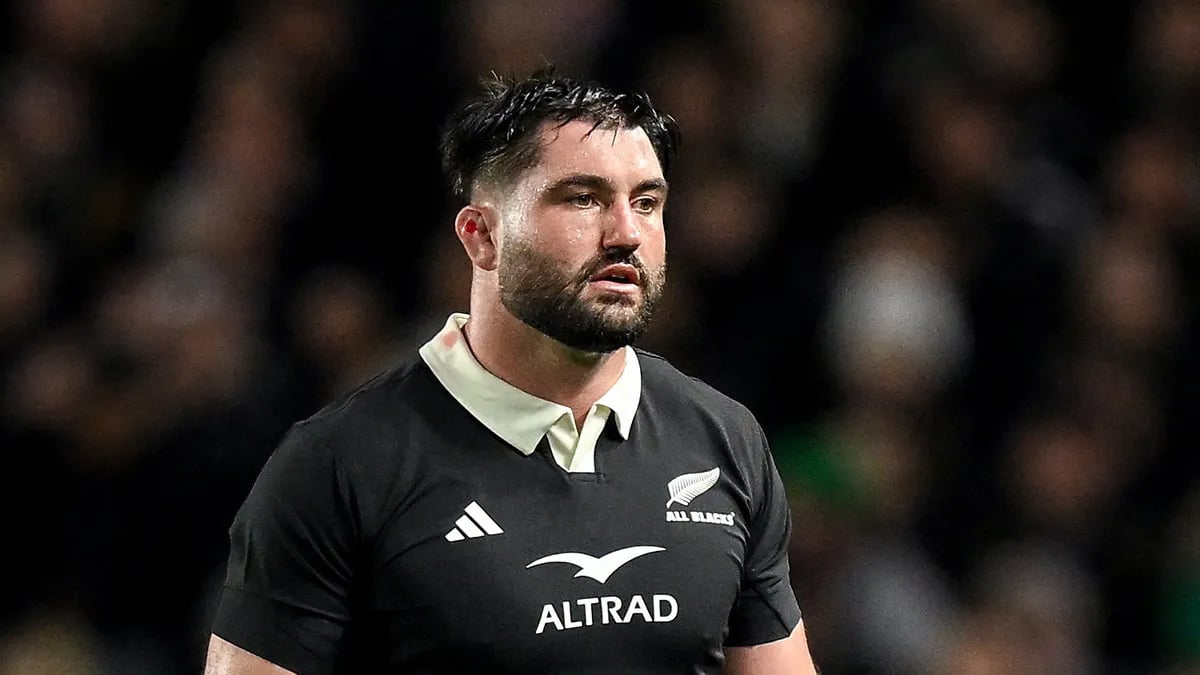
The All Blacks openside sat down with Martin Devlin on DSPN in the week of the third Test and talked through the penalty, the flu, the scrum from the back row and the series he does not expect to get twice. The fix for the penalty is one word long.
Luke Jacobson was asked about the penalty he gave away in Cape Town and blamed the only man he could fix by Saturday.
Not the referee. Not the jackal. Himself, and the height his shoulder arrived at.
He said it to Martin Devlin on DSPN’s tour podcast, published in the week of the third Test, before he starts at openside in the All Blacks side named for FNB Stadium for what New Zealand Rugby lists as his 30th Test. It only makes sense once you know this is the third Test running in which somebody with a whistle or a microphone has argued about a Luke Jacobson clean-out.
Luke Jacobson’s penalty, in his own words
Devlin’s question was vague. Jacobson corrected him, then volunteered the moment anyway.
“I don’t know if you’re referring to the penalty from on the weekend where I clean somebody… That was a clean-out. A lot of my intent at the breakdown is to take somebody to deck, and sometimes you’re working with small margins, and a ref might see it slightly differently to how you see it, or in the moment you might think it’s right but then it actually doesn’t look that flash.”
The referee’s reading, he said, was “that I’ve cleaned past the ball.” RugbyPass logged it in the 46th minute of the 33-26 defeat at DHL Stadium and read it as a flanker reaching for an involvement. Jacobson’s own reading is harsher, and more useful.
“You don’t get much time,” he said. “I’m going into that thinking I want to put somebody on the deck, and if he’s around the ruck, sweet, fair game. But it’s around pretty much how fast you get them to deck. You ride them a little bit and then you start taking them too far past the ruck, and that’s where you bring in things like penalties.”
Ride them a little bit. Hold that phrase, because it is the whole story.
Three Tests, three arguments about the same clean-out
Go back to Eden Park on Saturday 18 July. Jacobson hit Josh van der Flier at a ruck in the 27th minute with enough shoulder near the head that the review looked at a red. It stayed yellow. He was not cited.
Dave Rennie did not defend it. “It’s probably not the greatest decision,” the All Blacks head coach said, then the line that matters now: “He’s just got to be technically better in those situations.” Nigel Owens, who refereed a World Cup final, went further on World Rugby’s Whistle Watch. “Personally, I would have given a 20-minute red card for this.”
Then Ellis Park, Saturday 22 August, where he scored the fourth try in the 58th minute and was, by the Springboks’ own reckoning, the reason they kept losing the ball in the All Blacks 22. Steven Kitshoff, 83 caps at Springbok loosehead, on Kick Offs and Kick Ons: “I thought he really made it difficult for the Springboks at breakdown. The Springboks had a lot of opportunity within the 22, got stripped often.” The Springboks’ first review slide after Ellis Park was his breakdown work.
Same night, other channel. Victor Matfield, 127 Springbok caps, watched Marco van Staden binned for an illegal clear-out and Jacobson stay on for one he thought comparable. “How can that not be a penalty? What’s the difference?” It was one of the Carley calls that turned Ellis Park.
And then Cape Town, where the referee finally agreed with the pundits, and Jacobson agreed with the referee.
You have watched three Tests of this and drawn your own conclusion. Jacobson has drawn his, and it is not that the officials keep getting him wrong.
Luke Jacobson: The scrum from the seventh seat
The fix can wait a minute, because Devlin got to the scrum, as everyone does this month, and Jacobson’s answer was more careful than his coach’s.

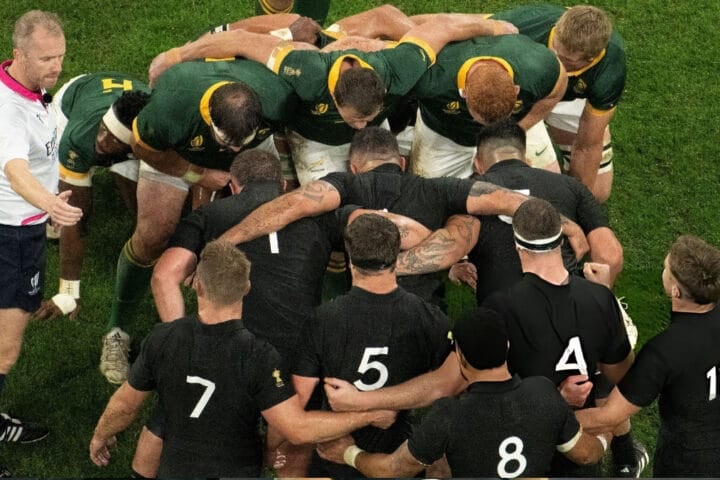
“There’s probably a few technical things in that first Test that ended up getting them quite a lot of dominance for a decent amount of that game, but a lot of it’s in the front row,” he said. “In the second Test I think it was a pretty even battle.”
Pretty even. Rennie’s word for Cape Town was “walking around”, and Daan Human answered him with six years and a farm. Jacobson is not contradicting his coach. He is describing the outcome while Rennie argues the method, and both can be true of the same eight scrums.
From the back row, it feels like this. “There’s definitely a few arts and crafts within there that, if it’s not being defended properly or countered properly, you feel the whole weight and your scrum ends up going backwards.”
“For me as a loose forward, it doesn’t feel very nice, cuz you’re going backwards and it’s like, what’s going on? But I guess at the front… I actually don’t know, that’s a little bit out of my league. But I know legalities or illegalities sometimes can make things easier.”
An openside binds on the lock and the prop in front of him. When the opposite tighthead side walks, the drive arrives on a diagonal and the flanker on that side takes the whole weight without seeing what caused it. Kieran Read says the Springboks scrum is legal. The man who feels it most says it is out of his league. Both are describing the same blind spot.
The flu, and the Tuesday legs
Jason Ryan gave it away the morning after Cape Town. “Lukey Jacobson had a bit of flu last night,” the All Blacks forwards coach said, and Peter Lakai, on from the bench in the second half, had been “exceptional”. Jacobson, who went off after 62 minutes, did not dress it up either.
“You start to acquire a few niggles and a few bumps and bruises, but the main thing is you’re back to good by Saturday. There’s been a bit of sickness going around the team in the last few weeks as well… Monday, Tuesday is maybe a little bit slow, but this has to be expected against a physical side like South Africa.”
So the openside who was ill overnight before the second Test starts the third, and the flanker who came off the bench that night starts beside him at six, with Simon Parker out of the 23 altogether. Rennie has backed the man who admits the fault over the one who did nothing wrong, against a side Jacobson calls “one of the hardest tests you will get, I think, as a rugby player”.
What “lower” actually changes
Here is the fix, in full.
“It’s around setting good pictures for the ref that… you don’t get penalised for those sorts of things. So I think I can be a little bit more accurate and probably hitting him a little bit lower, put him on the deck straight away, and then you don’t bring the referee into the decision.”
Lower is not a vague ambition. It is a mechanical one.
A jackal over the ball is folded at the hips with his weight through his feet and his hands past the ball. Hit him at chest height and his base holds, so the only place he can go is sideways and forward. The cleaner ends up driving a man who is no longer part of the contest, past the ball and outside the ruck, and the referee’s arm goes up. Hit him under the hips and the base breaks first. He goes down where he was standing, inside the ruck, and the ball is out the back before there is anything to look at.
Every clean-out Jacobson has been argued about this season is the same clean-out: the shoulder arriving a fraction high, and the ride that follows. Rennie called it technique in July. Jacobson has now called it technique himself.
He was honest about the rest of that afternoon. “I wasn’t overly happy with some of my collisions from the last game. So looking to get a few of those right for this last Test. Not last Test, sorry. Last Test in South Africa.”
And on referees, the line every openside in the world should tape inside his locker. “As soon as you bring it into the referee’s decision, that’s when you’re putting yourself at risk. So you just try and keep it out of that.”

Watch for it on Saturday. Malcolm Marx starts at hooker, and nobody in the game gets his hands past the ball faster. Where Marx finishes when Jacobson hits him is the whole examination. On the ball side of the ruck, play on. On the far side, still moving, Amashukeli has a decision to make, and Jacobson has told you he does not want to give him one.
Luke Jacobson: Soweto counts as the series, and he will not get another one
Ask him about the series and he counts differently from the fixture list.
“There’s four Test matches, aren’t there? But there’s three Test matches on South African soil. So we think if we can win this one, it’s pretty much a win in South Africa.”
John Smit says Soweto decides the series and Baltimore is a money game. Rennie, naming his team, put it as “the team that doesn’t win this weekend can’t win the series.” Jacobson’s version is the least diplomatic of the three, and Baltimore on Saturday 12 September is not in it.
He also described the first two minutes from the inside, once the anthem and the haka are done. “We come together after that, we grab a breath. We grab a few words of, usually, strategy, and just to dial in a little bit.” The haka is not the last thing that happens before kick-off. A huddle about the first exit is.
Then the line that makes a 29-year-old sound older.
“There’s been a lot of talk of ex-players and how, if there was one series that they would want to play and come out of retirement for, it would be this one… I definitely don’t think I will get another chance to do this… not take it for granted, and enjoy every moment of it and just try and live it to the fullest every week, every day.”
He was picked for the World Cup in Japan and never played a game of it, withdrawn with delayed concussion symptoms. Seven years on he has 29 Tests and a tour that will not be repeated inside his career. For where this series sits, and everything after Saturday, there is every fixture, result and kick-off time in Rugby’s Greatest Rivalry.

Your turn
Jacobson says the fix for his clean-out is lower and faster. Nigel Owens said in July the fix should have been a red card. Same shoulder, two answers. Which openside turns up at FNB Stadium on Saturday: the one who stripped the Springboks at Ellis Park, or the one who gave Angus Gardner a decision in Cape Town? Settle it below.
Frequently asked
Why was Luke Jacobson penalised against the Springboks in Cape Town?
He was penalised at a ruck in the 46th minute of the second Test for cleaning past the ball. In his own account on DSPN, he rode the man too far beyond the ruck, and the fix is to hit lower and put the jackal on the floor faster.
How many Tests has Luke Jacobson played?
The third Test at FNB Stadium on Saturday 5 September is his 30th, according to New Zealand Rugby. He made his debut against Argentina in the Rugby Championship seven years ago and has started every All Blacks Test of the current season.
Was Luke Jacobson suspended for the clean-out on Josh van der Flier?
No. He was shown a yellow card at Eden Park on Saturday 18 July, the card was upheld on review rather than upgraded, and he was not cited afterwards.







Comments
No one has weighed in yet.
Be the first - what did you make of it?