



Asked on Friday to account for nine All Blacks tries in two Tests, Mzwandile Stick said he does not see a problem in the Springboks defence system. The Cape Town stat sheet shows where he is right, and where the nine tries actually came from.
Nine tries in two Tests, and the Springboks coach asked to explain them on Friday said he does not see a problem.
Mzwandile Stick has been on the staff since 2018 and sat through two World Cup wins built on a defence that gave up almost nothing. He was not rattled by the question. He complimented New Zealand, then moved the blame to the other end of the field inside a minute.
He is right about the system. The number that shows where he is wrong is on the same stat sheet, and it is not a defensive number. It comes later. If you have already decided the Springboks defence is broken, the comments are open, and that number will not help your case.
What Stick actually said
At the captain’s press conference alongside Siya Kolisi on Friday 4 September, the day before the third Test of Rugby’s Greatest Rivalry at FNB Stadium, a journalist put the try count to Stick, the Springboks assistant coach, in a presser TimesLive reported the same afternoon. Nine, across the two late yellow cards that finished South Africa off at Ellis Park and a Cape Town win in which New Zealand still scored four tries to three.
“Some of the tries they scored, it’s well-executed tries. But once again, we also take pride in how we defend. So I wouldn’t say I see a problem in our system, but we must also give them compliments when they do well. It’s not like we’re not going to concede any points.”
Then the pivot, to his own attack.
“If I use both games as a reference, we also had opportunities in the first game. If I can talk about the stats, I think we had about 10 to 11 22-metre entries and only converted one. And then when they got an opportunity later with those yellow cards in that first game, then they buried them.”
His number is right. Opta had South Africa at ten entries into the New Zealand 22 at Ellis Park on Saturday 22 August, returning 0.7 points each time they got there, against a 2026 season average of five and a half. New Zealand made nine entries and returned 3.6. Two of their five tries came after Marco van Staden and Cobus Reinach were binned inside a minute of each other in the final quarter.
Read the answer again, though. Asked about the defence, Stick answered with the attack.
The man who said the opposite
Earlier in the week, on SuperSport’s Boks Unpacked, Schalk Burger, 86 Tests as a Springboks flanker and a 2007 World Cup winner, had looked at the same two matches and reached the other conclusion.
“We haven’t had consistently the same back three for a third week running, and if there’s a weakness for us, it’s our defence. So that’s where the challenge will come… So this weekend we’ll have to go with a mentality where we got to go score 40 points.”
Burger spent twelve years in that defensive line. Stick has coached it for eight. They watched the same match and disagree.
So look at what Cape Town says.
| New Zealand in Cape Town, Saturday 29 August | |
|---|---|
| Possession | 57 per cent |
| Carries | 154 to 104 |
| Passes | 246 to 93 |
| Line breaks | 8 to 5 |
| Springboks tackles made / missed | 188 / 39 |
| All Blacks tackles made / missed | 122 / 26 |
Source: New Zealand Rugby’s match report, allblacks.com.

The Springboks defence missed 39 tackles, and that is a volume, not a system
The Springboks were asked to make 188 tackles in Cape Town. They missed 39. On a night when the other side missed 26 from 122, that reads like a defence coming apart.
It did not.
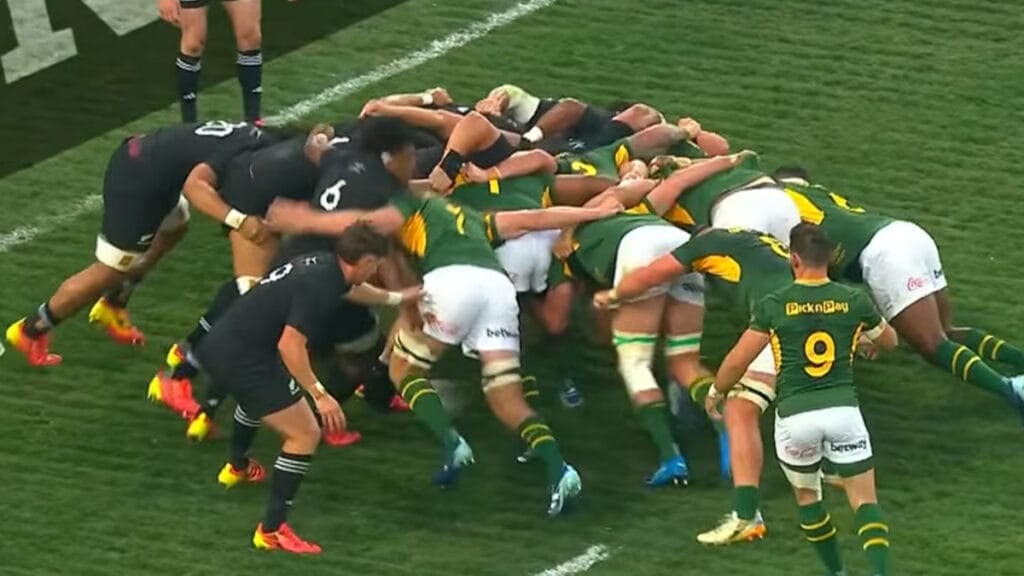
A blitz defence is built for a short game: one big tackle, then a reset. It defends the first two passes with numbers and the third with the sweeper. What it cannot do, by design, is defend the fifth pass, because by then the line speed that makes it work has carried the defenders past the ball. New Zealand made 246 passes to South Africa’s 93. The whole argument is in that row.
Rassie Erasmus, the Springboks head coach, went through the four Cape Town tries himself when he named the team on Monday 31 August. One came while a Springboks player was down injured and out of the line. One was a missed tackle, plain and named. “The other two,” he said, “they outplayed us and outsmarted us.” No excuse offered for half of them, from a coach who does not give those away.
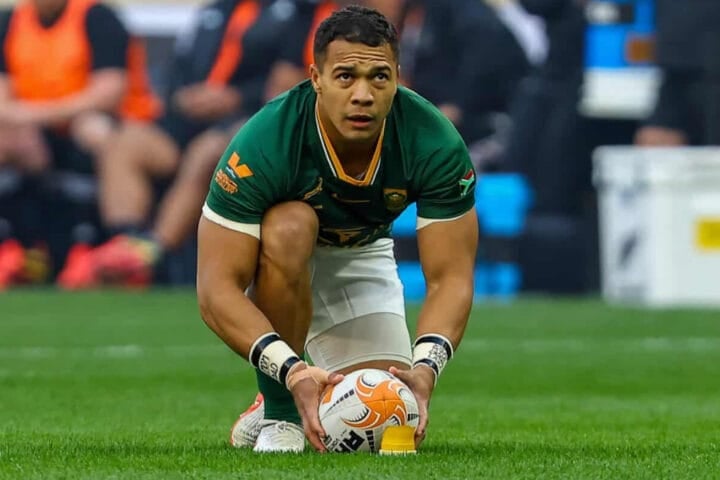
So the system held for the tries it was built to stop and broke for the ones no blitz stops: the wide ball after the fourth pass, one defender against one runner. Stick is right about the system. Burger is right about the exposure, and he named the reason: the third different back three in three weeks, with Cheslin Kolbe moved to fullback for the injured Damian Willemse and Kurt-Lee Arendse back on the wing for Saturday.

The number that settles it is not a defensive number
At Ellis Park South Africa had 61 per cent of the territory, led 13-12 at half-time, went into the New Zealand 22 ten times and scored once. In Cape Town they had 43 per cent of the ball, went into the All Blacks 22 four times, and that was enough for 33 points. Two opposite attacking nights. The defence conceded five tries in one and four in the other.
Put those side by side and the defence is not the variable. Possession is. A side that holds the ball for 57 per cent of a match and passes it 246 times will find the edge of any blitz eventually, and the tackle count climbs until the misses come. The Springboks defence did not lose the last quarter in Cape Town. An attack that managed nothing but three penalties after half-time left it on the field without a rest, and Ardie Savea’s try in the 77th minute was the bill.
Jean de Villiers, 109 Tests and Springboks captain from 2012 to 2015, said as much on the same Boks Unpacked show, and it is the sharper prescription.
“What I would like to see is just our intent from 40 m in, to the 22, that we maybe rather look at keeping ball in hand… We just need to fire some more shots this week.”
So, the number promised at the top. It is possession, and it sits on the attack’s side of the sheet. He was right to point at the attack. Wrong column, though: not the 22 conversion, which South Africa fixed in Cape Town, but the ball they handed back to New Zealand for 57 per cent of the night.
What to watch for at FNB Stadium
Three tells, in order.
- Where the miss happens. A miss inside the 15-metre lines, front-on, is a system fault. A miss on the touchline after four passes is a width problem, and it is the one Erasmus has already conceded.
- The pass count at half-time. Past 120 New Zealand passes by the break and the Springboks defence will be tackling into the last quarter with legs already gone, whatever the score says.
- Kolbe’s first high ball at fullback. Not because he will drop it. Because where he lands it decides whether South Africa get the possession this whole argument turns on.
Under all of it sits the last-quarter question: the bomb squad has not won the closing 30 minutes in either Test, and Erasmus did not argue the point. No bench finishes behind a Springboks defence that has been tackling since the 50th minute.
The verdict, and a number to hold this page to
Stick is half right, and it is the useful half. The system is sound. Nothing in Cape Town suggests Jerry Flannery’s line has stopped working front-on. The nine tries came from the edge and from two men in the bin, and the reason the edge was exposed for eighty minutes is that South Africa spent 57 per cent of the match without the ball.
For scale, New Zealand scored eight tries across the four Tests between these sides in 2024 and 2025. They have scored nine in two this series. The jump is real. Look for it in the possession column.
On the record, checkable at full time: if the Springboks hold half the possession at FNB Stadium, New Zealand score two tries or fewer. If New Zealand carry 150 times again, it will be four again, and on Sunday morning the wrong unit will get the blame.

Frequently asked
How many tries have the Springboks conceded to the All Blacks in the 2026 series?
Nine. Five at Ellis Park on Saturday 22 August, two of them while South Africa were down to 13 men, and four in Cape Town on Saturday 29 August. Across the four Tests between the sides in 2024 and 2025, New Zealand scored eight tries in total.
What did Mzwandile Stick say about the Springboks defence?
At the captain’s press conference on Friday 4 September he said he does not see a problem in the system, credited New Zealand for well-executed tries, and pointed to ten or eleven entries into the 22 at Ellis Park that produced one score.
Who is the Springboks defence coach?
Jerry Flannery, the former Ireland hooker, who took over the defence from Jacques Nienaber at the start of 2024. Tony Brown runs the attack and Stick is an assistant coach who has been on the staff since 2018.
Your turn
So which is it? Is the Springboks defence broken, or is it being asked to do the attack’s job for it? The nine tries and the 43 per cent are above. Settle it below.





Comments
No one has weighed in yet.
Be the first - what did you make of it?