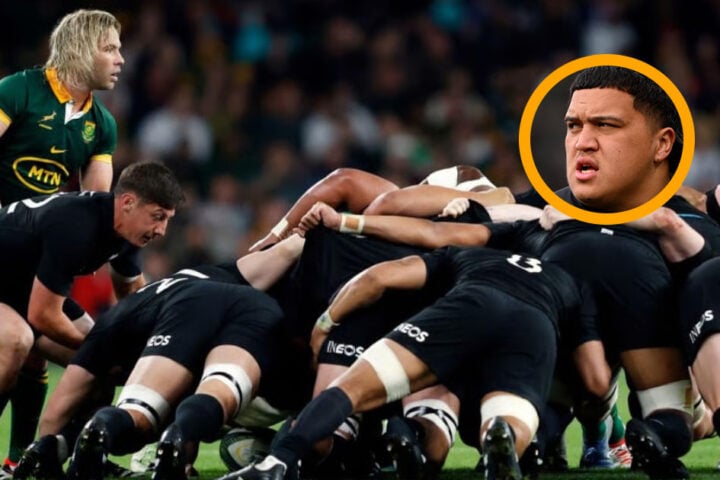

“At the moment we’re just not doing it good enough.” Wallace Sititi, four days out from a Test the All Blacks have to win, on the one thing his side cannot do with a referee. The All Blacks penalty count from Soweto says he is talking about something bigger than discipline.
Twelve penalties against New Zealand. Eleven against South Africa.
One penalty in it across eighty minutes at FNB Stadium, and a five-point defeat that ended the series as a contest. New Zealand can square it in Baltimore on Saturday. They cannot win it.
A reporter in Washington asked what the review had found. The number underneath the answer did not travel with it: the penalty count at FNB Stadium finished 12 against New Zealand and 11 against South Africa.
Sititi knew.
“I think our penalty count definitely has to improve… I think it was a bit [of an] even penalty count between the two teams. I think the Springboks just took the opportunities a bit better than we did.”
Read the middle clause again. A young loose forward, four days out from the biggest match of his season, telling a room full of reporters that the discipline column was level and the difference was somewhere else.
So which is it: a side that cannot keep its hands off the ball, or a side that only offends in the one place it cannot afford to? Pick one in the comments before Saturday.
The All Blacks penalty count was almost level. The Springboks scored 29 anyway.
Nika Amashukeli blew twenty-three penalties in Soweto and split them almost down the middle. Out of New Zealand’s twelve came a penalty try, four more penalties, and one of those penalties became the lineout, the twenty-metre maul and Malcolm Marx’s try. Fourteen points, and not one of them needed a line break.
Out of South Africa’s eleven, New Zealand got seven, when Ruben Love kicked to the corner on ten minutes and Ardie Savea drove over from the ruck. Nothing after that, because South Africa have kicked eight penalty goals in this series and New Zealand none.
Same offence rate. Twice the points.
“It’s anywhere you give away penalties, it’s always an issue. Not just the breakdown like you mentioned, but sort of anywhere. And I guess we’re just giving them easy entries into our 22, and they’re capitalising on it a bit better than we are.”
“Easy entries into our 22.” Five words, and they reframe the argument. Not a discipline problem. A geography problem.
Where you concede it decides what it costs
A penalty conceded on halfway is an inconvenience. They kick to touch, you contest the lineout, and if the throw is good you are defending on your own ten-metre line with fourteen phases still ahead of them.
A penalty conceded inside your own 22 is a different transaction. Three points on the tee, or a lineout five metres out with a maul behind it, or a scrum on your line against a pack that has spent a fortnight proving what it does with one. No defensive system survives that often.
Read also: the five mistakes that decided the third Test, and how many of them started with a whistle rather than a missed tackle.
Watch the yard line on Saturday before you watch the replay. The number that decides Tests is the distance from the offender to his own posts, and nobody puts that on a graphic.
South Africa turned twelve penalties into fourteen points. New Zealand turned eleven into seven, and took one shot at goal all night. Love missed it from the left of the posts on 53 minutes.
Sititi was asked whether it is even fixable
The follow-up put it to him straight: is this a mindset thing, given it is an interpretive game and the referee decides what a ruck actually is.
“It’s a bit of mindset, bit of accuracy. There’s rules there for a reason and we’ve got to make sure we follow it to the best of our ability, and when we get pinged from the ref we’ve got to be able to adapt there, and at the moment we’re just not doing it good enough.”
“At the moment we’re just not doing it good enough.”
Nobody in the All Blacks camp has said anything as blunt on this tour. Not the head coach, who has spent two press conferences being generous to everybody in sight.
He came on for Ardie Savea after 31 minutes in Soweto. Now he is telling the travelling press that his side is failing at the most basic skill in Test rugby: hearing what a referee wants and changing before he says it twice.
Adapting is a skill, not a mood. It looks like a captain asking one question at the first scrum penalty and getting a usable answer. It looks like a blindside warned about his entry angle taking a wider arc for twenty minutes, whatever he thinks of the call.
Sides that do it well concede three penalties in the first quarter and one in the last. The ones that do not give away the same offence at 12 minutes and again at 62.
His attack coach was asked the same question and gave the other answer
The exchange that makes the Washington session worth watching twice happened before Sititi sat down. A reporter asked Mike Blair, the All Blacks attack coach, whether he wants referees managing the breakdown out loud, the running commentary of hands off, six, you’re coming in, move out the way, rather than simply blowing the penalty.
Blair defended the officials first, and that should be printed with what followed. A referee could make a different call twenty or thirty times a Test. It is a hard job. What the All Blacks ask for is consistency.
Then came the line.
“I think if you’re doing something illegal, you should be penalised for it.”
Twenty minutes later the same question went to Sititi.
“Obviously it’s a bit easier if they compensate it for you. But at the same time, the refs are going to ref the game as they see fit, and we just got to adapt to it.”
The coach wants the whistle. The player wants the warning.
Neither man is complaining, and neither should be dressed up as one. This is a week when Dave Rennie told the same press corps that referees hunting one foot at a scrum stop seeing the rest of it and a Crusaders coach called Ruben Love’s yellow card the harshest in Test history. The gap between the answers is still real, and it is the gap a side falls into at 61 minutes with a one-score lead. The coach has built an attack that needs clean ball. The player would take the referee’s voice over the referee’s arm every time, because the voice costs nothing and the arm costs three.
Three men flew home and the review still happened
New Zealand went into that review without their captain. Ardie Savea will not travel to Baltimore after dislocating his shoulder, Luke Jacobson has an elbow tendon injury and Quinn Tupaea a knee ligament. Nine players were released in all.
“Every game is a must win in this black jersey, in this environment. So that’s the mindset that we’re going into with this weekend. I’ve had a pretty stern review today… and now it’s about moving forward, and [we’ve] got a big test on Saturday.”
What makes that worth quoting is who was not in the room to run it.
Read next: six things New Zealand were missing in Soweto, and the five still fixable by Saturday.
Frequently asked
What was the All Blacks penalty count against the Springboks in Soweto?
Twelve penalties were awarded against New Zealand and eleven against South Africa in the third Test at FNB Stadium on Saturday 5 September, which South Africa won 29-24.
What did Wallace Sititi say about the All Blacks penalty count?
Sititi said it has to improve, but he also said the count was close to even between the two sides and that “the Springboks just took the opportunities a bit better than we did”. His wider point was that New Zealand are giving South Africa easy entries into their own 22.
Where and when did Wallace Sititi say this?
At the All Blacks media session in Washington DC on Tuesday 8 September 2026, published on the All Blacks YouTube channel. Attack coach Mike Blair spoke at the same session, and Ardie Savea, Luke Jacobson and Quinn Tupaea had already flown home injured.
Your turn
Two readings of the same twelve penalties. Either New Zealand have a discipline problem and the count flatters them, because a side conceding at that rate will eventually concede one on its own line. Or the count is fine and the problem is field position, and a side that stops giving the ball away in its own half concedes the same twelve and pays nothing for them.
One of those gets fixed at a captain’s run. The other takes a season. Which one did the All Blacks lose the third Test to?